
After searching for two whole years, I think I finally found the answer to my Wii modding problems. You see, I've been wanting to play Japanese games on the Wii to help improve my language skills, but buying a pre-modded Wii requires the sacrificing of an arm or leg in cash, and buying a chip and paying someone to mod it is a.) not practical where I live, and b.) still way too expensive. There's also no way I'm going to risk my system being damaged by me tinkering around with it myself.
So, I luckily found this guy who sells a product that will teach you how to mod your Wii without one of those expensive little chips, and doing so will allow one to play not only Japanese games, but emulators, DVDs, music, and all that other stuff that the Playstation 3 and Xbox can do. Unlocking the Wii is a great thing to do, but I still haven't found a relatively inexpensive way to do the same for the PS3...
Anyway, I highly recommend you check it out. The Wii was a great idea from Nintendo, although not all games lend themselves well to the motion control gimmick, but then again, not every movie lends itself well to the 3D gimmick; the Wii's biggest problem being that in a world where gaming consoles are almost little computers in themselves that can play DVDs and share online content, Wii tried to be a basic gaming console whose only real upgrades were that you could browse the Internet and shop for games you might already own on their online store. I love the virtual console as much as anyone else, but there's too few games for some systems.
So, if you're interested, go here and see if this looks like something you'd like.
Friday, September 30, 2011


Wednesday, September 28, 2011
The Lion King 3D
I went to see The Lion King last Saturday in 3D, not so much for the 3D, but for the nostalgia factor. I was in 3rd grade when the movie first came out, and I was more than eager to see it in theaters. In fact, I can't really remember any other movie in my childhood that I was this excited to see other than Aladdin, as that was the first movie I ever saw in theaters. No, The Lion King had me excited, and it affected me in a very deep way.
Needless to say, when Disney was re-releasing it, I was excited. Unlike others on the Internet who were crying, "Cash-in!" and taunting Disney for being unable to make anything new and original, thus stooping to re-releasing older films in 3D, I personally got all tingly inside. It was such a huge part of my childhood and created so many memories for me, seeing as how you couldn't get away from the film, even in the classroom, that I couldn't wait to see it again and watch all the parents bringing in their own children to share it with them.
Now, I don't need to review the film itself, as most people have already seen it a million times. It's a great combination of humor, tragedy, and destiny that few movies manage to mingle to harmoniously with. And, yes, it knocks the socks off of Kimba the White Lion, for those in the audience ready to storm Disney Studios with pitchforks, torches, and AK-47s. And I'll also say that if you're going to knock this film, then maybe you should take a look at Disney's The Little Mermaid, which had scenes taken almost frame-by-frame from an old anime movie - although I still admit that the Disney version is superior, even if they gave it a happy ending.
The question most potential movie-goers are asking is, "Is the 3D worth it?" Allow me to give a resounding, "YES!" I was a bit skeptical at first, especially given that it's an animated film, and especially given that 3D is still in a stage where it's usually more of a gimmick than an experience, but The Lion King lends itself surprisingly well to the medium.
The opening is amazing. It was amazing all those years ago when I first saw it, and it was astounding again, leaving me awestruck. The ending was amazing as well, and the 3D gives the African savanna a depth that makes one feel as though he's looking over an actual plane on the Pride Lands. Everything just looked great, despite the fact that the movie was animated.
I really only had gripes with a few scenes. The 3D effect disappeared at times, although it was neither completely obvious or distracting, and it kind of lessoned the song "I Just Can't Wait to Be King" - a song which could have greatly beneffited it. I also expected a little more of the infamous stampede, but I was so caught up in the emotion of that scene that I honestly didn't care that wildebeasts weren't flying into my face.
So for any last-minute movie-goers wondering if they want to see this movie in 3D, I say to give it a go. It's by far the best post-production 3D film I've seen, and it manages to leave you slack-jawed a few times throughout the film. Go ahead and see it, and if you know of any kids, make sure they go see it too. Oh, and for anybody wondering, yes, this movie is still traumatizing kids, but in a good way. Everyone should see it; it's easily one of Disney's very best.
Monday, March 7, 2011
Morrowind vs. Oblvion
Internet forums, youtube, fansite, etc. are all littered with this question and variants of it: what’s better? Morrowind or Oblivion? The flame wars start and all sorts of names get thrown around, insults hurled at random people, and, in forums, the moderators either close down threads at the speed of clicks or hide away until the members start to chill a bit. As such, I am fully aware that this post will probably get me flamed. Bring it on! You’re entitled to your opinion, too. However, here’s my take on the whole Morrowind vs. Oblivion argument.
Story: So, which game had the best story to tell? Before I go on, I’m going to declare this one a tie. Both Oblivion and Morrowind had great stories, in my opinion, and for different reasons.
I loved how Oblivion just threw you into its tale and gave you this sense of urgency that Morrowind lacked. The king himself is killed whilst trying to flee his castle, but not before giving you your task and some mumbo jumbo about destiny. After which, you hear that the town of Kvatch has been destroyed. Who doesn’t want to just rush in and help those poor people? That was always number one on my list!
Morrowind’s plot was more subtle, allowing you to immerse yourself fully in the environment before unraveling your character’s role in the story. Morrowind gets points because the story seems more intricate. I didn’t feel any sense of urgency when I landed in Vvardenfell (no town to rescue and feel that surge of accomplishment), but I felt more part of the world when things finally did start picking up. That’s what is so great about Morrowind, in my opinion.
So, yes, I enjoyed them both. I have no real preference. Oblivion’s epic plotline was great for its game, and Morrowind’s plot was great for it. I know that some people bash Oblivion’s unoriginal and generic you-must-save-the-world-from-total-evil story, but, hey, that story works fine! Yes, it’s in-your-face, but it really fit with the high fantasy atmosphere of Oblivion, I think.
Setting: I’m going to get killed for this, but I preferred Oblivion’s high fantasy setting (or “familiarity” for those who insist on bashing) to Morrowind’s weird look. Morrowind’s world just looked like a place I wouldn’t want to live, whilst Cyrodil was a place I kept thinking, “You know, I could settle down here,” just about everywhere I went. Vvardenfell almost looks like the Mordor of Tamriel in certain spots, which is a real turn off.
Now, some of Morrowind looked great! The northern regions I liked well, and some of the countryside was breathtaking with the right mods, but Oblivion just looked good all around. Its architecture, city layouts, etc. all just made me feel good inside.
However, Morrowind has one huge advantage over Oblivion that made the developers look lazy: it’s not randomly generated! O how amazing Oblivion would have been if every cave and every dungeon was hand-made the way that Morrowind was! Oblivion did get bland sometimes after you’ve seen your umpteenth cave and it’s not too terribly different from any other randomly generated cave you’ve been to.
I suppose another advantage Morrowind has is that it’s a politically diverse world. Vvardenfell has many political structures and people vying to influence policy. For the politically-inclined, such as myself, this was great and added a sense of realism to Morrowind. The closest we got to that in Cyrodil was a certain racist Countess, and nothing interesting ever came of that.
The graphics, the artwork, the look: I don’t care what anybody says; Oblivion’s characters look a million times better than Morrowind’s. Sure, some of the people in Cyrodil look bloated and kind of ugly, but at least they don’t look like walking corpses! The first thing I did after booting up Morrowind and seeing the deplorable faces I had to choose from when creating my character was go get some mods! Now, I don’t consider myself a shallow person by any means, but I do want to be able to distinguish the characters I’m interacting with from Ocarina of Time’s Redeads!
Morrowind characters look like someone took a picture of someone else, cut their face out with scissors, and tried really hard to bend it into a 3D model. It just looks wrong sometimes.
Contrary to popular belief, it is possible to get a decent looking character in Oblivon. It takes a while, as the character creation tried to be the Sims 2 and just didn’t get it quite right, but it is, nonetheless, possible.
Apart from the character designs, I’m not going to nitpick. Oblivion was a newer game, and it looked better than Morrowind. I would have been shocked if the graphics didn’t improve during that time, so it doesn’t count.
Animation: Again, I’m going to go with Oblivion. I know what you’re saying. “You just said that you weren’t going to compare the two together in graphics, but you’ll compare how well animated it is?!?” Well, there’s one thing bugging me about Morrowind that has nothing to do with the level of technology as it existed back then: the way Argonians and Khajits walk! Seriously, Argonians look like constipated chickens when they’re out on a stroll. I like how they move in Oblivion.
Content: Morrowind, hands down, although it pains me to admit it. I’m going from the vanilla standpoint here (vanilla including official expansion packs and plugins), so the amount of modding for each game doesn’t count. Let’s face it, you ran out of things to do in Oblivion much quicker than you did in Morrowind. It was kind of crappy, because I found that role-playing in Oblivion was more fun than in Morrowind, but there was nothing more to do without resorting to mods! Sure, Shivering Isles added some new, and bizarre, fun to the game, but it was the only expansion pack, and it just sort of paled in comparison to Morrowind’s. Granted, this is because I love werewolves and Bloodmoon introduced them, thus radically changing gameplay if you became one.
The problem with Oblivion is that the quests, while fun, aren’t exceptionally challenging, and there just aren’t enough of them. You could try and shake things up by becoming a vampire, but vampires are treated as savage beasts in this game (no “factions”), and there’s really only one vampire-related quest. I also didn’t get how your character becomes stronger by avoiding blood. That just didn’t make much sense to me.
Now, I enjoyed some of the guild quests more in Oblivion than Morrowind. The Thieves’ Guild had some amazing twists in it and I was fully absorbed init, and The Dark Brotherhood had the Who Dun It quest has got to be one of the very best in any Elder Scrolls game ever, but Morrowind still had more to do. It takes a lot longer to get through everything in Morrowind than it does in Oblivion, and after a while, everything in Oblivion starts to look and feel the same.
I’d say the only thing Oblivion really has over Morrowind is the ability to buy and own houses. If you’re like me, you like to have a house full of your crap to really make you feel a part of the world. Oblivion does this in spades! If Morrowind had this feature, I guarantee its immersion factor would have gone up.
Gameplay: I’m going to go with Oblivion, although Morrowind has one huge advantage. A lot of what Oblivion did was pretty innovative in terms of how much interactivity a player can have with his environment. You can not only take anything you want, but you can pick it up and manipulate it. You can drag bodies all over the place if you want, or arrange something on a shelf for viewing purposes. This was a huge bonus in my book!
I also really like how it was easier to sneak and tell whether your actions with an object would count as stealing or not. When sneaking, you had this eye thing in the middle of the screen that would turn gold if you could be seen. Not to mention, you also knew when something belonged to someone else, so I didn’t run into the trouble I did in Morrowind.
I’m also going to say that I greatly enjoyed combat in Oblivion whereas it was a huge pain in Morrowind. Morrowind’s combat played like a table-top RPG; every swing of your sword and every draw on your bow had a success rate dependent on the roll of the dice, basically. That’s why my Khajit can’t hit anything with a sword to save his life, even though he’s standing right in front of the darn monster, whereas my Nord has practically zero long-range capabilities. Was Oblivion a button masher? You bet, but I enjoyed it. And it wasn’t like it took player skill in Morrowind; rather it was all chance-based.
Did Morrowind have any advantage over Oblivon? Yep, it does. Oblivion does this annoying thing of leveling monsters based on your character's level. It also gives you better items the higher leveled you are. This is bad because when your character reaches a certain level, the best armor is found in every shop, the best items can be drug out of any cave, and every cave is easily beaten. Now, I don’t mind leveling for some of the events, such as Oblivion gates or story-based battles, but I’d like to go into a cave and run away with my tail between my legs and the sad realization that that cave is just way beyond me right now. I’d also like the best armor to be hard to get, not readily available once my character’s level gets high enough. Immersion, people! As Gandalf would point out, some foes are just beyond us!
NPCs and Stuff: Yeah, what a wonderful name for a category, huh? Anyway, here we go on the non-playable characters and everything surrounding them. I don’t really have a clear-cut winner for this one, quite frankly. It’s not a tie, but it’s not like one vastly triumphs over the other. Let’s start with Oblivion, then, shall we?
The NPCs in Oblivion are much more complex. They have schedules, seem to live lives of their own, and have their own personalities. In other words, they seem more real. There are a few downsides to them, though. The first being that they have voice actors to portray them. Now, Oblivion is one of the few games that I can stand the voices in. They’re acted very well and don’t sound like dubbed characters from a Japanese RPG (stares at FF). However, there’s not much diversity among the voices, giving the (false) impression that each NPC is basically the same.
This also limits the number of topics you’re able to talk about with them. In Morrowind, the characters don’t really have voices. A few key characters do, but most characters just grumble their mandatory line as you walk past them. This is bad for Morrowind because each character really does seem to sound the same, but, because the dialogue itself is just text, you’re able to have longer, more in-depth conversations with the characters.
In Morrowind there’s was always a large variety of topics available to talk about. Granted, once you talked about “rumors” or “specific place” or whatever with one character, you probably won’t get a different response from any other characters (they all talk relatively alike, which is a negative point), but at least you can ask about so many different things. Oblivion just kind of gives you one or two topics, and if that topic proves interesting, you might get a few different options to talk about. In a way, it makes conversing more streamlined, but it also feels very limited compared to Morrowind. I’m willing to bet that they did this because of having to pay the voice actors.
As far as both games go, I was kind of sad that they each would sometimes present a very interesting character and then never really delve into anything special with him or her. I found the racist Countess in Oblivion to be very interesting (even rumored to have a torture chamber under her castle where she kills Khajits and Argonians), but this wasn’t expanded upon at all! There was also a certain man who was a vampire, and I really didn’t expect someone like him to be one, yet he’s a relatively background character, aside from a quest. The Gray Fox was interesting, and Sheogorath was another well-developed character, but they seemed to have skimmed over a number of potentially interesting characters.
My Dream Elder Scrolls Game: So, what would be the very best game, in my opinion? Off the top of my head, I can say that there are a number of things I’d like. The first would be Skyrim-style graphics. If the trailer actually represents the game’s actual look, I’d say that’s a good sign. Definitely good graphics, and, of course, I prefer the high fantasy setting as opposed to a more alien landscape, although a few weird spots (think Shivering Isles) is just fine.
On that note, wouldn’t it be awesome if it was as large as Daggerfall, yet as hand-crafted as Morrowind? No randomly generated crap, please. It gets very stale, very quickly. That was Daggerfall’s biggest problem, although I loved how huge it was. I know, budget is king, but remember, this is my dream game, not what I actually expect to be accomplished.
Since Oblivion taught me that voice acting in video games can sound realistic and not overly hyper or melodramatic, I wouldn’t mind voice acting again, as long as there’s more diversity. A handful of people trying to provide voice for all the characters per race is just too much to ask. Every Redguard can’t sound the same, and why do Argonians and Khajit sound pretty much the same? Please, diversify the voices.
On that note, I would love a heavily-populated game. Cities should have more than twenty people or so. In my dream game, where budget, lag, technological limitations, etc. wouldn’t exist, I’d have a hundred or more NPCs per city, each with his own personality, topics, interests, etc. It would also be a plus if Bethesda could figure out that Radiant AI thing they were trying with Oblivion before declaring it a failure.
Let’s see, I’d also vote for no scale leveling, unless it’s an essential part of the story. I don’t want to feel confident enough to face any enemy the game throws at me, knowing that it’s automatically scaled to my level. No, Skyrim’s leveling thing doesn’t sound like a good fix to me, because it still means that all the new bad guys you face are scaled to your level; the only difference being that when you go to an area and encounter the enemies you’ve already faced, they’re going to be that much easier because they’re locked on the level you first faced them at. Hopefully I misinterpreted that, but this just seems wrong. Nope, I’d have locked levels for most of the random enemies you encounter.
Also, no level scaled items, either. This goes without saying, but rare items should be rare. I don’t want to come across a traveling merchant (yes, the NPCs in my dream game would include traveling merchants), selling all kinds of amazing armor because I’m at a high level. That kills the point of it being amazing armor, in my opinion.
I don’t mind having fast travel for the people who enjoy that kind of thing, but horses should be available as well as a transportation system Morrowind-style. A hybrid of the two games would be best. A hardcore mode that requires you to sleep and eat at regular intervals would be great, too, but only as an option.
I’d also like professions. Skyrim seems to be fixing this problem by allowing you to farm, mine, etc. in their game, and that’s going to be a plus, if done well. I would love to roleplay my character as an average guy if I really wanted to.
I’d also like instruments in the game. Why? Well, wouldn’t it be awesome to be a traveling minstrel or something? A Morrowind plug-in allowed for an instrument to be played in one of the inns, but it wasn’t special. It really wouldn’t be hard to implement the kind of freestyle playing I’d like, either. Ocarina of Time did it with its title instrument, and The Lord of the Rings Online does it extremely well.
The act of enchanting could be a little more immersive. Maybe mini-game styled. Yeah, I know, I’ll get killed for that, but was Oblivion’s lock-picking “game” really so bad?
Last, but not least, mods are a must. They seriously increase the longevity of the games. Both Morrowind and Oblivion are still around for one good reason: mods. You can expand upon the game in virtually any way, even to the point of creating a whole new land and story if you’re so inclined. It takes some knowledge and a lot of time, but a good mod is definitely worth it.
So, there we have it. My take on this debate. Flame away!
Story: So, which game had the best story to tell? Before I go on, I’m going to declare this one a tie. Both Oblivion and Morrowind had great stories, in my opinion, and for different reasons.
I loved how Oblivion just threw you into its tale and gave you this sense of urgency that Morrowind lacked. The king himself is killed whilst trying to flee his castle, but not before giving you your task and some mumbo jumbo about destiny. After which, you hear that the town of Kvatch has been destroyed. Who doesn’t want to just rush in and help those poor people? That was always number one on my list!
Morrowind’s plot was more subtle, allowing you to immerse yourself fully in the environment before unraveling your character’s role in the story. Morrowind gets points because the story seems more intricate. I didn’t feel any sense of urgency when I landed in Vvardenfell (no town to rescue and feel that surge of accomplishment), but I felt more part of the world when things finally did start picking up. That’s what is so great about Morrowind, in my opinion.
So, yes, I enjoyed them both. I have no real preference. Oblivion’s epic plotline was great for its game, and Morrowind’s plot was great for it. I know that some people bash Oblivion’s unoriginal and generic you-must-save-the-world-from-total-evil story, but, hey, that story works fine! Yes, it’s in-your-face, but it really fit with the high fantasy atmosphere of Oblivion, I think.
Setting: I’m going to get killed for this, but I preferred Oblivion’s high fantasy setting (or “familiarity” for those who insist on bashing) to Morrowind’s weird look. Morrowind’s world just looked like a place I wouldn’t want to live, whilst Cyrodil was a place I kept thinking, “You know, I could settle down here,” just about everywhere I went. Vvardenfell almost looks like the Mordor of Tamriel in certain spots, which is a real turn off.
Now, some of Morrowind looked great! The northern regions I liked well, and some of the countryside was breathtaking with the right mods, but Oblivion just looked good all around. Its architecture, city layouts, etc. all just made me feel good inside.
However, Morrowind has one huge advantage over Oblivion that made the developers look lazy: it’s not randomly generated! O how amazing Oblivion would have been if every cave and every dungeon was hand-made the way that Morrowind was! Oblivion did get bland sometimes after you’ve seen your umpteenth cave and it’s not too terribly different from any other randomly generated cave you’ve been to.
I suppose another advantage Morrowind has is that it’s a politically diverse world. Vvardenfell has many political structures and people vying to influence policy. For the politically-inclined, such as myself, this was great and added a sense of realism to Morrowind. The closest we got to that in Cyrodil was a certain racist Countess, and nothing interesting ever came of that.
The graphics, the artwork, the look: I don’t care what anybody says; Oblivion’s characters look a million times better than Morrowind’s. Sure, some of the people in Cyrodil look bloated and kind of ugly, but at least they don’t look like walking corpses! The first thing I did after booting up Morrowind and seeing the deplorable faces I had to choose from when creating my character was go get some mods! Now, I don’t consider myself a shallow person by any means, but I do want to be able to distinguish the characters I’m interacting with from Ocarina of Time’s Redeads!
Morrowind characters look like someone took a picture of someone else, cut their face out with scissors, and tried really hard to bend it into a 3D model. It just looks wrong sometimes.
Contrary to popular belief, it is possible to get a decent looking character in Oblivon. It takes a while, as the character creation tried to be the Sims 2 and just didn’t get it quite right, but it is, nonetheless, possible.
Apart from the character designs, I’m not going to nitpick. Oblivion was a newer game, and it looked better than Morrowind. I would have been shocked if the graphics didn’t improve during that time, so it doesn’t count.
Animation: Again, I’m going to go with Oblivion. I know what you’re saying. “You just said that you weren’t going to compare the two together in graphics, but you’ll compare how well animated it is?!?” Well, there’s one thing bugging me about Morrowind that has nothing to do with the level of technology as it existed back then: the way Argonians and Khajits walk! Seriously, Argonians look like constipated chickens when they’re out on a stroll. I like how they move in Oblivion.
Content: Morrowind, hands down, although it pains me to admit it. I’m going from the vanilla standpoint here (vanilla including official expansion packs and plugins), so the amount of modding for each game doesn’t count. Let’s face it, you ran out of things to do in Oblivion much quicker than you did in Morrowind. It was kind of crappy, because I found that role-playing in Oblivion was more fun than in Morrowind, but there was nothing more to do without resorting to mods! Sure, Shivering Isles added some new, and bizarre, fun to the game, but it was the only expansion pack, and it just sort of paled in comparison to Morrowind’s. Granted, this is because I love werewolves and Bloodmoon introduced them, thus radically changing gameplay if you became one.
The problem with Oblivion is that the quests, while fun, aren’t exceptionally challenging, and there just aren’t enough of them. You could try and shake things up by becoming a vampire, but vampires are treated as savage beasts in this game (no “factions”), and there’s really only one vampire-related quest. I also didn’t get how your character becomes stronger by avoiding blood. That just didn’t make much sense to me.
Now, I enjoyed some of the guild quests more in Oblivion than Morrowind. The Thieves’ Guild had some amazing twists in it and I was fully absorbed init, and The Dark Brotherhood had the Who Dun It quest has got to be one of the very best in any Elder Scrolls game ever, but Morrowind still had more to do. It takes a lot longer to get through everything in Morrowind than it does in Oblivion, and after a while, everything in Oblivion starts to look and feel the same.
I’d say the only thing Oblivion really has over Morrowind is the ability to buy and own houses. If you’re like me, you like to have a house full of your crap to really make you feel a part of the world. Oblivion does this in spades! If Morrowind had this feature, I guarantee its immersion factor would have gone up.
Gameplay: I’m going to go with Oblivion, although Morrowind has one huge advantage. A lot of what Oblivion did was pretty innovative in terms of how much interactivity a player can have with his environment. You can not only take anything you want, but you can pick it up and manipulate it. You can drag bodies all over the place if you want, or arrange something on a shelf for viewing purposes. This was a huge bonus in my book!
I also really like how it was easier to sneak and tell whether your actions with an object would count as stealing or not. When sneaking, you had this eye thing in the middle of the screen that would turn gold if you could be seen. Not to mention, you also knew when something belonged to someone else, so I didn’t run into the trouble I did in Morrowind.
I’m also going to say that I greatly enjoyed combat in Oblivion whereas it was a huge pain in Morrowind. Morrowind’s combat played like a table-top RPG; every swing of your sword and every draw on your bow had a success rate dependent on the roll of the dice, basically. That’s why my Khajit can’t hit anything with a sword to save his life, even though he’s standing right in front of the darn monster, whereas my Nord has practically zero long-range capabilities. Was Oblivion a button masher? You bet, but I enjoyed it. And it wasn’t like it took player skill in Morrowind; rather it was all chance-based.
Did Morrowind have any advantage over Oblivon? Yep, it does. Oblivion does this annoying thing of leveling monsters based on your character's level. It also gives you better items the higher leveled you are. This is bad because when your character reaches a certain level, the best armor is found in every shop, the best items can be drug out of any cave, and every cave is easily beaten. Now, I don’t mind leveling for some of the events, such as Oblivion gates or story-based battles, but I’d like to go into a cave and run away with my tail between my legs and the sad realization that that cave is just way beyond me right now. I’d also like the best armor to be hard to get, not readily available once my character’s level gets high enough. Immersion, people! As Gandalf would point out, some foes are just beyond us!
NPCs and Stuff: Yeah, what a wonderful name for a category, huh? Anyway, here we go on the non-playable characters and everything surrounding them. I don’t really have a clear-cut winner for this one, quite frankly. It’s not a tie, but it’s not like one vastly triumphs over the other. Let’s start with Oblivion, then, shall we?
The NPCs in Oblivion are much more complex. They have schedules, seem to live lives of their own, and have their own personalities. In other words, they seem more real. There are a few downsides to them, though. The first being that they have voice actors to portray them. Now, Oblivion is one of the few games that I can stand the voices in. They’re acted very well and don’t sound like dubbed characters from a Japanese RPG (stares at FF). However, there’s not much diversity among the voices, giving the (false) impression that each NPC is basically the same.
This also limits the number of topics you’re able to talk about with them. In Morrowind, the characters don’t really have voices. A few key characters do, but most characters just grumble their mandatory line as you walk past them. This is bad for Morrowind because each character really does seem to sound the same, but, because the dialogue itself is just text, you’re able to have longer, more in-depth conversations with the characters.
In Morrowind there’s was always a large variety of topics available to talk about. Granted, once you talked about “rumors” or “specific place” or whatever with one character, you probably won’t get a different response from any other characters (they all talk relatively alike, which is a negative point), but at least you can ask about so many different things. Oblivion just kind of gives you one or two topics, and if that topic proves interesting, you might get a few different options to talk about. In a way, it makes conversing more streamlined, but it also feels very limited compared to Morrowind. I’m willing to bet that they did this because of having to pay the voice actors.
As far as both games go, I was kind of sad that they each would sometimes present a very interesting character and then never really delve into anything special with him or her. I found the racist Countess in Oblivion to be very interesting (even rumored to have a torture chamber under her castle where she kills Khajits and Argonians), but this wasn’t expanded upon at all! There was also a certain man who was a vampire, and I really didn’t expect someone like him to be one, yet he’s a relatively background character, aside from a quest. The Gray Fox was interesting, and Sheogorath was another well-developed character, but they seemed to have skimmed over a number of potentially interesting characters.
My Dream Elder Scrolls Game: So, what would be the very best game, in my opinion? Off the top of my head, I can say that there are a number of things I’d like. The first would be Skyrim-style graphics. If the trailer actually represents the game’s actual look, I’d say that’s a good sign. Definitely good graphics, and, of course, I prefer the high fantasy setting as opposed to a more alien landscape, although a few weird spots (think Shivering Isles) is just fine.
On that note, wouldn’t it be awesome if it was as large as Daggerfall, yet as hand-crafted as Morrowind? No randomly generated crap, please. It gets very stale, very quickly. That was Daggerfall’s biggest problem, although I loved how huge it was. I know, budget is king, but remember, this is my dream game, not what I actually expect to be accomplished.
Since Oblivion taught me that voice acting in video games can sound realistic and not overly hyper or melodramatic, I wouldn’t mind voice acting again, as long as there’s more diversity. A handful of people trying to provide voice for all the characters per race is just too much to ask. Every Redguard can’t sound the same, and why do Argonians and Khajit sound pretty much the same? Please, diversify the voices.
On that note, I would love a heavily-populated game. Cities should have more than twenty people or so. In my dream game, where budget, lag, technological limitations, etc. wouldn’t exist, I’d have a hundred or more NPCs per city, each with his own personality, topics, interests, etc. It would also be a plus if Bethesda could figure out that Radiant AI thing they were trying with Oblivion before declaring it a failure.
Let’s see, I’d also vote for no scale leveling, unless it’s an essential part of the story. I don’t want to feel confident enough to face any enemy the game throws at me, knowing that it’s automatically scaled to my level. No, Skyrim’s leveling thing doesn’t sound like a good fix to me, because it still means that all the new bad guys you face are scaled to your level; the only difference being that when you go to an area and encounter the enemies you’ve already faced, they’re going to be that much easier because they’re locked on the level you first faced them at. Hopefully I misinterpreted that, but this just seems wrong. Nope, I’d have locked levels for most of the random enemies you encounter.
Also, no level scaled items, either. This goes without saying, but rare items should be rare. I don’t want to come across a traveling merchant (yes, the NPCs in my dream game would include traveling merchants), selling all kinds of amazing armor because I’m at a high level. That kills the point of it being amazing armor, in my opinion.
I don’t mind having fast travel for the people who enjoy that kind of thing, but horses should be available as well as a transportation system Morrowind-style. A hybrid of the two games would be best. A hardcore mode that requires you to sleep and eat at regular intervals would be great, too, but only as an option.
I’d also like professions. Skyrim seems to be fixing this problem by allowing you to farm, mine, etc. in their game, and that’s going to be a plus, if done well. I would love to roleplay my character as an average guy if I really wanted to.
I’d also like instruments in the game. Why? Well, wouldn’t it be awesome to be a traveling minstrel or something? A Morrowind plug-in allowed for an instrument to be played in one of the inns, but it wasn’t special. It really wouldn’t be hard to implement the kind of freestyle playing I’d like, either. Ocarina of Time did it with its title instrument, and The Lord of the Rings Online does it extremely well.
The act of enchanting could be a little more immersive. Maybe mini-game styled. Yeah, I know, I’ll get killed for that, but was Oblivion’s lock-picking “game” really so bad?
Last, but not least, mods are a must. They seriously increase the longevity of the games. Both Morrowind and Oblivion are still around for one good reason: mods. You can expand upon the game in virtually any way, even to the point of creating a whole new land and story if you’re so inclined. It takes some knowledge and a lot of time, but a good mod is definitely worth it.
So, there we have it. My take on this debate. Flame away!
Monday, December 7, 2009
Revival!
Just letting everyone know that these blogs aren't dead! It's been a very hectic time for me, and I'm getting back into the swing of things. Just to let everyone who might be following this know, I have recently begun teaching on eduFire, so that'll be taking up a blog post in the future. So, here's some articles you can expect to see here and on my other blogs.
Nerdy Goodness:
EduFire
An article regarding the upcoming movie, The Last Airbender
Much more!
Genki:
Bashing Rosetta Stone (I hate this program)
Review for The Melancholy of Haruhi Suzumiya
Much more!
Politcal Retreat:
Ranting and raving about our crappy administration.
Nerdy Goodness:
EduFire
An article regarding the upcoming movie, The Last Airbender
Much more!
Genki:
Bashing Rosetta Stone (I hate this program)
Review for The Melancholy of Haruhi Suzumiya
Much more!
Politcal Retreat:
Ranting and raving about our crappy administration.
Monday, May 11, 2009
Seagates are Tough Little Buggers
Today I’m .advertising Seagate’s FreeAgent external hard drives. Why? Because the manufacturer isn’t kidding when they say it’s built to last!
I got up this morning, laptop and external in my arms, and scurried down the stairs only to find that my brother had neglected to unlock the door at the bottom before he left for school. It’s one of those locks that is basically like a latch. I can’t remember the exact name for them, but the purpose of them isn’t security. It’s a little metal latch that fits into a little metal ring, thus preventing the cats from opening doors they shouldn’t.
Anyway, I was in a rush because I had to start on Duke’s medication and physical therapy, so I quickly shuffled back up the stairs to find a piece of notebook paper I could use to the unlock the door. On my way back, I took the first step down and the external slipped out from under my burdened arms!
I could feel the blood leaving my face, running cold and turning me pale. The little box was bouncing on its corners, down every step, and not stopping. I could hear bits of plastic breaking as it turned the corner and my heart just about stopped. I’m sure that even non-computer geeks can understand that feeling, as it’s about the equivalent of realizing you just dropped your infant kid down the stairs.
When that horrible noise stopped, I slowly began my descent, wondering what I would find at the bottom. I found the external hard drive sitting at the very bottom of the stairs, one corner busted off and its wires exposed. The first thing I did was, naturally, pick it up and shake it, hearing a faint rattle inside, presumably a piece of the corner. The top and bottom pieces of the outer shell had popped off. The top managed to go back on easily, despite a corner missing, but I still haven’t gotten the bottom on nicely.
I thought to myself, “Well, it’s gone. How much data did I have on here? What can be replaced? What is going to send me into a prolonged grieving period?”
I unlocked the door and mournfully set the computer up, not expecting the little hard drive to even kick on. I plugged both the laptop and external hard drive in and booted it up. Sure enough, I could hear the drive making its normal sounds and the lights came on. I breathed a sigh of relief that perhaps it could be repaired, although I didn’t expect it to load any files.
It takes my laptop an interminable amount of time to boot up, probably because of all the junk I have on it, so during this time I managed to take care of Duke and come back out for a look. Seeing as how it had loaded, I went into My Computer and found the FreeAgent icon happily waiting there. I held my breath and double-clicked the icon, wanting to look away as my cursor became a little hourglass. However, within seconds I was looking at all my folders on the external, not believing that it was actually working. I went into a folder to play a video clip, figuring that if it could load that, it could load any picture or word document on there, and it played. The sound seemed to fade out a bit every now and then, but it was great.
So, I got to work on burning a DVD for my negligent brother. I wasn’t about to lend him my DVD, as that would be the equivalent of kissing it goodbye, but the whole thing burned and works!
So, buy Seagate! I don’t know how long my little external will last, but it survived the initial falling down the stairs episode. I didn’t expect it to! Now, if only I knew where to send it for repairs…
I got up this morning, laptop and external in my arms, and scurried down the stairs only to find that my brother had neglected to unlock the door at the bottom before he left for school. It’s one of those locks that is basically like a latch. I can’t remember the exact name for them, but the purpose of them isn’t security. It’s a little metal latch that fits into a little metal ring, thus preventing the cats from opening doors they shouldn’t.
Anyway, I was in a rush because I had to start on Duke’s medication and physical therapy, so I quickly shuffled back up the stairs to find a piece of notebook paper I could use to the unlock the door. On my way back, I took the first step down and the external slipped out from under my burdened arms!
I could feel the blood leaving my face, running cold and turning me pale. The little box was bouncing on its corners, down every step, and not stopping. I could hear bits of plastic breaking as it turned the corner and my heart just about stopped. I’m sure that even non-computer geeks can understand that feeling, as it’s about the equivalent of realizing you just dropped your infant kid down the stairs.
When that horrible noise stopped, I slowly began my descent, wondering what I would find at the bottom. I found the external hard drive sitting at the very bottom of the stairs, one corner busted off and its wires exposed. The first thing I did was, naturally, pick it up and shake it, hearing a faint rattle inside, presumably a piece of the corner. The top and bottom pieces of the outer shell had popped off. The top managed to go back on easily, despite a corner missing, but I still haven’t gotten the bottom on nicely.
I thought to myself, “Well, it’s gone. How much data did I have on here? What can be replaced? What is going to send me into a prolonged grieving period?”
I unlocked the door and mournfully set the computer up, not expecting the little hard drive to even kick on. I plugged both the laptop and external hard drive in and booted it up. Sure enough, I could hear the drive making its normal sounds and the lights came on. I breathed a sigh of relief that perhaps it could be repaired, although I didn’t expect it to load any files.
It takes my laptop an interminable amount of time to boot up, probably because of all the junk I have on it, so during this time I managed to take care of Duke and come back out for a look. Seeing as how it had loaded, I went into My Computer and found the FreeAgent icon happily waiting there. I held my breath and double-clicked the icon, wanting to look away as my cursor became a little hourglass. However, within seconds I was looking at all my folders on the external, not believing that it was actually working. I went into a folder to play a video clip, figuring that if it could load that, it could load any picture or word document on there, and it played. The sound seemed to fade out a bit every now and then, but it was great.
So, I got to work on burning a DVD for my negligent brother. I wasn’t about to lend him my DVD, as that would be the equivalent of kissing it goodbye, but the whole thing burned and works!
So, buy Seagate! I don’t know how long my little external will last, but it survived the initial falling down the stairs episode. I didn’t expect it to! Now, if only I knew where to send it for repairs…
Tuesday, May 5, 2009
Pride and Prejudice and Zombies
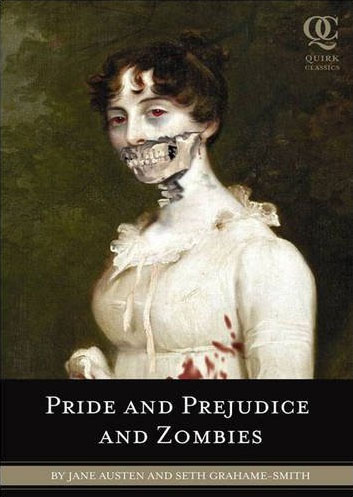
I actually left my hometown for a shopping trip, aren't you proud? Shopping trips for me usually involve clicking over to Amazon.com or Ebay, but this time I actually drove into a city. Anyway, I waltzed on into a book store hoping to find Atlast Shrugged, but my bookstore is pretty stinky, and they didn't have it. I also went on a quest to find some C++ books, not the "For Dummies" stuff, but an actual book to help replace the one my kitty shredded. No such luck there, either. For some reason, bookstores in my area completely lack anything interesting, save for a book I once picked up called "Weird Minnesota", which I will review later, and a quirky book I found on this trip, Pride and Prejudice and Zombies, by Jane Austen and Seth Grahame-Smith. This is the book, same plot and all, with zombie goodness in it.
First of all, I am not a Jane Austen fan, so I didn't go into this book as a purist. I went in thinking, "Cool! Someone's actually attempting to liven this dreary book up!" So sue me, but I have better things to read about than a bunch of women speculating their prospective suitors, such as reading a novel about dragons and wizards, a book explaining how our lack of free markets and the Federal Reserve have crashed our fiat currency, or even a book about a crazy sailor whose goal is to exact his revenge upon a certain unique whale.
So, how did I like this book? It was certainly interesting. 80% of the book is Jane Austen's original text, sprinkled with touches of zombies and talk of a warrior's pride, while the rest of ultra-gruesome zombie action. How gruesome, you ask? I'll just give you a heads up before I continue, so look away now if you don't wish to know.
First of all, the decaying zombies are often times described in vivid detail. Even the most squeamish person around can probably stand this, but it also describes in vivid detail how they come upon their victims and proceed to eat them alive.
Elizabeth also has a penchant for beheading the creatures, and she also strangles a man with his own entrails and bites into a fresh heart. Not very ladylike, eh?
There's also one character who gets infected with the zombie virus (I didn't know that could happen until after you're dead, but whatever), and slowly turns into one. This is supposed to be comical, and it is, with a hint of tragedy, but it can also be pretty darned gross at times.
So, now that that's out of the way, and if you're still interested, I bet you want to know if the additional stuff actually works. I'm pleased to say that it does, for the most part.
The English countryside is occupied by zombies, or, as this book often refers to them, unmentionables. Being trained in combat is a must if you hope to survive, so the Benett sisters are sent to China to learn the ways of the Shaolin. Of course, there's the normal marriage prospects, etc., but this is all sprinkled with the fact that zombies are running around lose, and no one knows how to stop them!
It's very easy to suspend disbelief and acknowledge that by "occupation" they mean "zombie invasion" and not a military reference. However, I must admit that I had a harder time swallowing the whole ninja sideplot. In a day and age when the Western world largely looked down upon the Oriental, the idea of sending away women to learn karate and martial arts is a bit of a stretch. The whole Japanese pagoda thing was a little off-beat, too, but this book doesn't even try to take itself seriously, so just go with it and laugh.
Some of the book's highlights include a better explanation as to why Charlotte decided to marry Mr. Collins at all, a much colder, stronger Elizabeth, and lots of zombies. With any luck a movie will grace the silver screen soon, but first we have to finish with Pride and Predator, which is said novel with aliens instead of zombies.
First of all, I am not a Jane Austen fan, so I didn't go into this book as a purist. I went in thinking, "Cool! Someone's actually attempting to liven this dreary book up!" So sue me, but I have better things to read about than a bunch of women speculating their prospective suitors, such as reading a novel about dragons and wizards, a book explaining how our lack of free markets and the Federal Reserve have crashed our fiat currency, or even a book about a crazy sailor whose goal is to exact his revenge upon a certain unique whale.
So, how did I like this book? It was certainly interesting. 80% of the book is Jane Austen's original text, sprinkled with touches of zombies and talk of a warrior's pride, while the rest of ultra-gruesome zombie action. How gruesome, you ask? I'll just give you a heads up before I continue, so look away now if you don't wish to know.
First of all, the decaying zombies are often times described in vivid detail. Even the most squeamish person around can probably stand this, but it also describes in vivid detail how they come upon their victims and proceed to eat them alive.
Elizabeth also has a penchant for beheading the creatures, and she also strangles a man with his own entrails and bites into a fresh heart. Not very ladylike, eh?
There's also one character who gets infected with the zombie virus (I didn't know that could happen until after you're dead, but whatever), and slowly turns into one. This is supposed to be comical, and it is, with a hint of tragedy, but it can also be pretty darned gross at times.
So, now that that's out of the way, and if you're still interested, I bet you want to know if the additional stuff actually works. I'm pleased to say that it does, for the most part.
The English countryside is occupied by zombies, or, as this book often refers to them, unmentionables. Being trained in combat is a must if you hope to survive, so the Benett sisters are sent to China to learn the ways of the Shaolin. Of course, there's the normal marriage prospects, etc., but this is all sprinkled with the fact that zombies are running around lose, and no one knows how to stop them!
It's very easy to suspend disbelief and acknowledge that by "occupation" they mean "zombie invasion" and not a military reference. However, I must admit that I had a harder time swallowing the whole ninja sideplot. In a day and age when the Western world largely looked down upon the Oriental, the idea of sending away women to learn karate and martial arts is a bit of a stretch. The whole Japanese pagoda thing was a little off-beat, too, but this book doesn't even try to take itself seriously, so just go with it and laugh.
Some of the book's highlights include a better explanation as to why Charlotte decided to marry Mr. Collins at all, a much colder, stronger Elizabeth, and lots of zombies. With any luck a movie will grace the silver screen soon, but first we have to finish with Pride and Predator, which is said novel with aliens instead of zombies.
Sunday, April 19, 2009
Philosophy and the Legend of Zelda
Remember way back when I said that I got this book for Christmas? Well, I finally have gotten the chance to read it, and it sure is interesting. Granted, unless you enjoy discussing philosophy, you're not going to get much out of this book, Zelda fan or not, but if you do, then you're in for a real, nerdy treat!
Basically, what it is, is a discussion of philosophy, a series of essays, really, written by academics, using the Zelda series as an example. As I said, if I were to embark on such a task, I probably wouldn't use Zelda, but I'm glad that they did, as I collect stuff from the series. You can take almost every angle of philosophy and somehow apply it to a Zelda game, and it is enjoyable to read. Granted, I don't agree with a certain number of philosophical viewpoints presented in this collection of essays, but that didn't stop me from going ga-ga over it.
There's really not much to say about it, since, unlike other book essays/reviews, this is more of an academic type of book that is completely seeped in nerdyness. Do I recommend getting it? Yes, unless, of course, you hate philosophy with a passion. As for me, I could write a Zelda book about political science, but that'll have to wait.
I do plan on doing a more interesting book review, and that would be Pride and Prejudice and Zombies. Yes, it's an actual book, and it might end up being an actual movie. In my opinion, sticking zombies in almost any book would improve it, but this might be a good read. I'll have to keep my eyes peeled.
Basically, what it is, is a discussion of philosophy, a series of essays, really, written by academics, using the Zelda series as an example. As I said, if I were to embark on such a task, I probably wouldn't use Zelda, but I'm glad that they did, as I collect stuff from the series. You can take almost every angle of philosophy and somehow apply it to a Zelda game, and it is enjoyable to read. Granted, I don't agree with a certain number of philosophical viewpoints presented in this collection of essays, but that didn't stop me from going ga-ga over it.
There's really not much to say about it, since, unlike other book essays/reviews, this is more of an academic type of book that is completely seeped in nerdyness. Do I recommend getting it? Yes, unless, of course, you hate philosophy with a passion. As for me, I could write a Zelda book about political science, but that'll have to wait.
I do plan on doing a more interesting book review, and that would be Pride and Prejudice and Zombies. Yes, it's an actual book, and it might end up being an actual movie. In my opinion, sticking zombies in almost any book would improve it, but this might be a good read. I'll have to keep my eyes peeled.
Friday, April 17, 2009
Susan Boyle vs. Britain's Got Talent
I hate American Idol, so I probably hate it's clone, Britain's Got Talent. However, I was pretty darned impressed with a video from it that my mom sent me. Here's the basic rundown of it before I post the video.
Susan Boyle is a 47-year-old virgin (was I the only one impressed by this?), who longs to be a professional singer but has never been given the chance. So, she walks her stumpy self up on a stage to sing for the most shallow audience in the world (what did you expect of an audience that watches this show?), and to be judged by our three shallow judges. One is that guy from American Idol, another is an older guy I've never seen, and the third is your standard I'm-only-here-to-be-blonde-and-beautiful type of person.
So, this funny, quirky woman begins the interview as to how old she is, what her dream is, etc. all the while the judges smirk at her, the audience laughs and boos, and then she starts to sing "I Dreamed a Dream" from Les Miserables, and it sounds a whole heck of a lot like that one lady who played Fantine in the Les Miserables dream cast. Needless to say, the audience is now shocked, cheering, and she walks away with three yes's. I have no idea what those yes's mean, but it's apparently good.
Anyway, this is a great, inspiring video that isn't allowed to be embedded, so I'll just link you to it: http://www.youtube.com/watch?v=9lp0IWv8QZY
It sounds like a story that could be reworked into a poorly written Disney film, but it's real-life. It's a great video to watch, and it's apparently very popular on youtube right now. The video my mom sent me had way more than a million views on it.
Susan Boyle is a 47-year-old virgin (was I the only one impressed by this?), who longs to be a professional singer but has never been given the chance. So, she walks her stumpy self up on a stage to sing for the most shallow audience in the world (what did you expect of an audience that watches this show?), and to be judged by our three shallow judges. One is that guy from American Idol, another is an older guy I've never seen, and the third is your standard I'm-only-here-to-be-blonde-and-beautiful type of person.
So, this funny, quirky woman begins the interview as to how old she is, what her dream is, etc. all the while the judges smirk at her, the audience laughs and boos, and then she starts to sing "I Dreamed a Dream" from Les Miserables, and it sounds a whole heck of a lot like that one lady who played Fantine in the Les Miserables dream cast. Needless to say, the audience is now shocked, cheering, and she walks away with three yes's. I have no idea what those yes's mean, but it's apparently good.
Anyway, this is a great, inspiring video that isn't allowed to be embedded, so I'll just link you to it: http://www.youtube.com/watch?v=9lp0IWv8QZY
It sounds like a story that could be reworked into a poorly written Disney film, but it's real-life. It's a great video to watch, and it's apparently very popular on youtube right now. The video my mom sent me had way more than a million views on it.
Tuesday, April 14, 2009
An Explanation of the Mental Health Liberation Movement
I need to write an article, but my brain is rather stumped. Not much happening in my nerdy world (except for the fact that Charlie the Unicorn 3 is out now), so I'm going to write another chapter of my antipsychiatry mini-series. Don't groan! No one's forcing you to read this...well, at least I'm not. At any rate, keep and open mind and go forth!
I've already posted my reasons as to why I am antipsychiatry, and also a follow-up piece. In the first article, I talked briefly about the myths surrounding the mental health liberation movement and antipsychiatry in general, explained the fundamental differences between psychiatrists and psychologists, and then began my choppy (the article was way too long to post, so it had to be edited) endeavor of debunking psychiatry as it stands today. Now, I would like to elaborate on those myths surrounding the antipsychiatry movement and explain the movement as a whole. Now that you know why psychiatry is a pseudo-science, time to read about how we're not all a bunch of quacks, hippies, alien worshippers, etc.
The first common myth is that all antipsychiatrists are Scientologists, and if you're not a Scientologist, then clearly your antipsychiatry beliefs are influenced by Scientology. First of all, I'm a Christian, not a Scientologist, and I don't believe just anything I read. I came to my conclusion after two years of psychology classes and independent study, not because Tom Cruise went on a rant on television and promted South Park to do a hilarious anti-Scientology episode. I will talk further on Scientology in this article, but for now you may rest assured that L. Ron Hubbard was neither the first antipsychiatrist nor the most influential.
Secondly, for some strange reason people accuse us of living in a dream world where no problems exist at all. It's as though we don't think that anyone suffers from extreme depression, hears voices, or knows anyone considered deeply mentally disturbed. What could be farther from the truth, I ask!
Anyone who read my first article is now well aware that I've seen it all. Between being severely suicidal (and pretty much given up on by every psychologist in the area) and watching my brother go through his own personal Hell due to his own problems, compounding upon by psychiatrists breathing down his neck, I can tell you that I do not live in a bed of roses, at least not on the part with the petals. In fact, a lot of people who have joined the movement in its various forms are people who call themselves psychiatric survivors. In other words, they were sometimes deeply disturbed people, or mildly disturbed people, who overcame their problems without medication, ECT (electroconvulsive therapy), and/or were actually harmed by their doctor. As I said before, we do not deny that people have problems, only that these problems stem from a biological basis, such as a chemical imbalance that no one can pinpoint or a genetic fault that cannot be traced.
All antipsychiatrists want to destroy psychiatry. This myth paints a broad picture if you ask me. Within the antipsychiatry sect, you will indeed find people like this, and admittedly, I sometimes wonder if I fit in with that train of thought as well. However, you will also find people who believe that psychiatry is simply in need of a severe reconstruction project. And then you will also find people who simply believe that psychiatrists should be more open to alternative solutions to problems and not so eager to force drugs on patients. There's a lot of different mindsets within the antipsychiatry community, some mild and some extreme and radical.
Finally, many people claim that antipsychiatrists are fear mongers. In other words, we have no problem spouting out why psychiatry is the devil's work, but cannot come up with how to actually deal with people who are severely depressed, have episodes of paranoia, ect. Actually, a lot of us do have solutions, and a wide variety at that. All the way from diet and lifestyle changes to special temporary retreats for healing, you'll find them all here!
With that, it's time to elaborate. The Mental Health Liberation movement consists of the general public (parents, grandparents, ect.), civil rights workers, psychiatric survivors, and even professionals, such as psychiatrists (go figure), psychologists, social workers, educators, etc. It also consists of people from all cultures and walks of faith. There are Christians, Muslims, Jews, Scientologists, Bhuddists, etc.
So, why is antipsychiatry almost exclusively associated with Scientology? I think the media (and Tom Cruise) has a lot to do with this. Let's face it, the best way to discredit an idea is to link it with an organization that everyone deems harmful, and Scientology is the perfect candidate! With its own horrendous human rights record, Scientology is very hypocritical in its crusade against the totalitarian regime known as the psychiatric industry.
Why is Scientology so against psychiatry, to the point of wanting it eradicated entirely? My personal theory, and I kid you not, is that Scientology is competing against psychiatry for converts. Seriously, think about this. One way that psychiatrists get clients is by administering a personality test. The questions are rather vague, repetitive, and can even conflict with faith (trust me, answering that you believe in the existence of demons doesn't reflect well when you take this test). As a joke, I once decided to take the online Scientology questionaire and found out it was astonishingly like the personality psychiatrists and psychologists hand out. The questions were so similar, I double-checked the address bar to ensure that I had it correct.
To make a long story short, I never got to see how Scientologists would "diagnose" me. You have to go to one of their bases in order to get that information, and I didn't want to do that (not to mention the nearest one is hours away from here), so I didn't get it. It probably would have said that I was depressed or anxious (they all do) and then encourage me to join their cult and get "cured". Sound familiar? This is exactly how psychiatry works! You're ill, so you need their services. It's a marketing ploy, and both of these industries use it.
I should also note at this point that one of the most aggressive protestors against psychiatry would be the Citizens Commission on Human Rights, which was co-founded by Scientology and Thomas Sasz, who, as far as I've discovered, is not a Scientologist. Technically, the CCHR is a seperate entity from the Church of Scientology, although you can tell that their alien-loving buddies work closely with them. Their official site praises the Church of Scientology by noting their "remarkable" human rights activism. Riiiight....
At any rate, I don't discourage anyone from going to the CCHR web site and watching their videos, as they're highly informative. I once read a pro-psychiatrist guy say that the group's documentaries decieve people with half-truths and outright lies. I double-checked everything, and have found very few lies and few half-truths. The Skinner box from their Psychiatry: An Industry of Death consisted of lies and half-truths, but pretty much the rest of that documentary passed my scrutiny, and their other documentary, Making a Killing is great!
Also, the CCHR is open to all people, not just Scientologists, and I think the staff is pretty well mixed at that.
Okay, that out of the way, let's discuss the various goals of antipsychiatrists, starting the the ones we can all agree on.
First of all, regardless of how extreme you are, we can all agree that forced hospitalization and forced drugging and electroshock must come to an end. These are blatant attacks on a person's civil rights. I mean, even criminals have the right to stand trial! People who are deemed mentally unstable by the system should have that right as well. Let a jury decide if you're sane or not. Even better would be if psychiatry stood trial and had to prove beyond a reasonable doubt that mental illness exists as a biological problem, but that's just too good to be true.
Second, I think we can safely say that psychiatrists should be more open to alternative solutions, not just the tools the pharmaceutical industry. Their training is almost funding entirely by Big Pharma while they're in college, and I don't think they do a whole lot of independent research regarding the safety of the drugs they are encouraged to push. There are many different things that could be causing emotional distress in a person's life, and drugs should not be the first option on the table.
Beyond that, we tend to differ a lot. I think that psychiatry's role in the mental health system should be restricted to that of caring for deeply disturbed people. Once upon a time, homes existed for the severely mentally disturbed. These weren't really asylums, but quite luxurious homes that would provide a safe haven for people until they came out of their psychosis on their own. Most of the time, if you remove a person from their stressors and give them a place to relax, pray, etc., they will recover naturally. Unfortunately, once the government got involved the quality of care at these homes decreased rapidly, and they fell out of existence. I think they should come back, unfunded by the government and Big Pharma (since I don't think psychotropic drugs should exist).
Some people think that psychiatry should be abolished entirely, and that psychologists, pastors and other religious leaders, etc. should take over for them. In other words, no psychotropic drugs would exist (good thing), but also no way to help people who may need a bit more than psychotherapy. I do believe that the Church should be more involved with helping people in distress, but Christians were infiltrated by psychiatry propaganda a long time ago. Without pscyhiatry, the Church could help more people who may be suffering from a spiritual crisis, nutritionists and alternative medicine practitioners in other areas, and psychologists for people who may just need to talk out their problems.
It's getting late now and I'm sleepy, so I'm going to mention the other organizations involved in the movement that are not affiliated with any religion, government, etc.
Able Child - They focus on school-aged children being drugged senseless.
MindFreedom - A great group that consists of many psychiatric survivors. If you're being coerced by psychiatry, trapped in the system, or are basically experiencing a loss of civil rights, these guys will help you out. They are aware that criminals have more rights than a psychiatric patient, and they will fight for you in any way that they can. Great, great group.
The Antipsychiatry Coalation - I don't think they do much other than write articles, but good reads anyway.
Well Mind Association of Minnesota - I presume this site is still growing. They provide information on alternative ways to treat mental illness.
Links coming soon! Not to mention a massive editing job!
I've already posted my reasons as to why I am antipsychiatry, and also a follow-up piece. In the first article, I talked briefly about the myths surrounding the mental health liberation movement and antipsychiatry in general, explained the fundamental differences between psychiatrists and psychologists, and then began my choppy (the article was way too long to post, so it had to be edited) endeavor of debunking psychiatry as it stands today. Now, I would like to elaborate on those myths surrounding the antipsychiatry movement and explain the movement as a whole. Now that you know why psychiatry is a pseudo-science, time to read about how we're not all a bunch of quacks, hippies, alien worshippers, etc.
The first common myth is that all antipsychiatrists are Scientologists, and if you're not a Scientologist, then clearly your antipsychiatry beliefs are influenced by Scientology. First of all, I'm a Christian, not a Scientologist, and I don't believe just anything I read. I came to my conclusion after two years of psychology classes and independent study, not because Tom Cruise went on a rant on television and promted South Park to do a hilarious anti-Scientology episode. I will talk further on Scientology in this article, but for now you may rest assured that L. Ron Hubbard was neither the first antipsychiatrist nor the most influential.
Secondly, for some strange reason people accuse us of living in a dream world where no problems exist at all. It's as though we don't think that anyone suffers from extreme depression, hears voices, or knows anyone considered deeply mentally disturbed. What could be farther from the truth, I ask!
Anyone who read my first article is now well aware that I've seen it all. Between being severely suicidal (and pretty much given up on by every psychologist in the area) and watching my brother go through his own personal Hell due to his own problems, compounding upon by psychiatrists breathing down his neck, I can tell you that I do not live in a bed of roses, at least not on the part with the petals. In fact, a lot of people who have joined the movement in its various forms are people who call themselves psychiatric survivors. In other words, they were sometimes deeply disturbed people, or mildly disturbed people, who overcame their problems without medication, ECT (electroconvulsive therapy), and/or were actually harmed by their doctor. As I said before, we do not deny that people have problems, only that these problems stem from a biological basis, such as a chemical imbalance that no one can pinpoint or a genetic fault that cannot be traced.
All antipsychiatrists want to destroy psychiatry. This myth paints a broad picture if you ask me. Within the antipsychiatry sect, you will indeed find people like this, and admittedly, I sometimes wonder if I fit in with that train of thought as well. However, you will also find people who believe that psychiatry is simply in need of a severe reconstruction project. And then you will also find people who simply believe that psychiatrists should be more open to alternative solutions to problems and not so eager to force drugs on patients. There's a lot of different mindsets within the antipsychiatry community, some mild and some extreme and radical.
Finally, many people claim that antipsychiatrists are fear mongers. In other words, we have no problem spouting out why psychiatry is the devil's work, but cannot come up with how to actually deal with people who are severely depressed, have episodes of paranoia, ect. Actually, a lot of us do have solutions, and a wide variety at that. All the way from diet and lifestyle changes to special temporary retreats for healing, you'll find them all here!
With that, it's time to elaborate. The Mental Health Liberation movement consists of the general public (parents, grandparents, ect.), civil rights workers, psychiatric survivors, and even professionals, such as psychiatrists (go figure), psychologists, social workers, educators, etc. It also consists of people from all cultures and walks of faith. There are Christians, Muslims, Jews, Scientologists, Bhuddists, etc.
So, why is antipsychiatry almost exclusively associated with Scientology? I think the media (and Tom Cruise) has a lot to do with this. Let's face it, the best way to discredit an idea is to link it with an organization that everyone deems harmful, and Scientology is the perfect candidate! With its own horrendous human rights record, Scientology is very hypocritical in its crusade against the totalitarian regime known as the psychiatric industry.
Why is Scientology so against psychiatry, to the point of wanting it eradicated entirely? My personal theory, and I kid you not, is that Scientology is competing against psychiatry for converts. Seriously, think about this. One way that psychiatrists get clients is by administering a personality test. The questions are rather vague, repetitive, and can even conflict with faith (trust me, answering that you believe in the existence of demons doesn't reflect well when you take this test). As a joke, I once decided to take the online Scientology questionaire and found out it was astonishingly like the personality psychiatrists and psychologists hand out. The questions were so similar, I double-checked the address bar to ensure that I had it correct.
To make a long story short, I never got to see how Scientologists would "diagnose" me. You have to go to one of their bases in order to get that information, and I didn't want to do that (not to mention the nearest one is hours away from here), so I didn't get it. It probably would have said that I was depressed or anxious (they all do) and then encourage me to join their cult and get "cured". Sound familiar? This is exactly how psychiatry works! You're ill, so you need their services. It's a marketing ploy, and both of these industries use it.
I should also note at this point that one of the most aggressive protestors against psychiatry would be the Citizens Commission on Human Rights, which was co-founded by Scientology and Thomas Sasz, who, as far as I've discovered, is not a Scientologist. Technically, the CCHR is a seperate entity from the Church of Scientology, although you can tell that their alien-loving buddies work closely with them. Their official site praises the Church of Scientology by noting their "remarkable" human rights activism. Riiiight....
At any rate, I don't discourage anyone from going to the CCHR web site and watching their videos, as they're highly informative. I once read a pro-psychiatrist guy say that the group's documentaries decieve people with half-truths and outright lies. I double-checked everything, and have found very few lies and few half-truths. The Skinner box from their Psychiatry: An Industry of Death consisted of lies and half-truths, but pretty much the rest of that documentary passed my scrutiny, and their other documentary, Making a Killing is great!
Also, the CCHR is open to all people, not just Scientologists, and I think the staff is pretty well mixed at that.
Okay, that out of the way, let's discuss the various goals of antipsychiatrists, starting the the ones we can all agree on.
First of all, regardless of how extreme you are, we can all agree that forced hospitalization and forced drugging and electroshock must come to an end. These are blatant attacks on a person's civil rights. I mean, even criminals have the right to stand trial! People who are deemed mentally unstable by the system should have that right as well. Let a jury decide if you're sane or not. Even better would be if psychiatry stood trial and had to prove beyond a reasonable doubt that mental illness exists as a biological problem, but that's just too good to be true.
Second, I think we can safely say that psychiatrists should be more open to alternative solutions, not just the tools the pharmaceutical industry. Their training is almost funding entirely by Big Pharma while they're in college, and I don't think they do a whole lot of independent research regarding the safety of the drugs they are encouraged to push. There are many different things that could be causing emotional distress in a person's life, and drugs should not be the first option on the table.
Beyond that, we tend to differ a lot. I think that psychiatry's role in the mental health system should be restricted to that of caring for deeply disturbed people. Once upon a time, homes existed for the severely mentally disturbed. These weren't really asylums, but quite luxurious homes that would provide a safe haven for people until they came out of their psychosis on their own. Most of the time, if you remove a person from their stressors and give them a place to relax, pray, etc., they will recover naturally. Unfortunately, once the government got involved the quality of care at these homes decreased rapidly, and they fell out of existence. I think they should come back, unfunded by the government and Big Pharma (since I don't think psychotropic drugs should exist).
Some people think that psychiatry should be abolished entirely, and that psychologists, pastors and other religious leaders, etc. should take over for them. In other words, no psychotropic drugs would exist (good thing), but also no way to help people who may need a bit more than psychotherapy. I do believe that the Church should be more involved with helping people in distress, but Christians were infiltrated by psychiatry propaganda a long time ago. Without pscyhiatry, the Church could help more people who may be suffering from a spiritual crisis, nutritionists and alternative medicine practitioners in other areas, and psychologists for people who may just need to talk out their problems.
It's getting late now and I'm sleepy, so I'm going to mention the other organizations involved in the movement that are not affiliated with any religion, government, etc.
Able Child - They focus on school-aged children being drugged senseless.
MindFreedom - A great group that consists of many psychiatric survivors. If you're being coerced by psychiatry, trapped in the system, or are basically experiencing a loss of civil rights, these guys will help you out. They are aware that criminals have more rights than a psychiatric patient, and they will fight for you in any way that they can. Great, great group.
The Antipsychiatry Coalation - I don't think they do much other than write articles, but good reads anyway.
Well Mind Association of Minnesota - I presume this site is still growing. They provide information on alternative ways to treat mental illness.
Links coming soon! Not to mention a massive editing job!
Thursday, April 2, 2009
David Holmes is a Quadriplegic
I couldn't think of a good headline, so here goes. Remember a while back, when I reported that Daniel Radcliffe's stunt double was hospitalized with a back injury? Apparently, doctors have said that there's a 95% chance that he'll be a quadriplegic for the rest of his life, prompting me to wonder how high the injury was to inflict such serious damage.
Now, I'm not one to be terribly pessimistic about injuries, so I think that Mr. Holmes will recover to a certain extent. I'm no doctor, but I do know plenty of quadriplegics who have defied their diagnosis with hard work, and with quite a bit of money/insurance...
I don't have a facebook account, but for anyone who does, his brother has put a page for get well wishes. You may write to him here.
Now, I'm not one to be terribly pessimistic about injuries, so I think that Mr. Holmes will recover to a certain extent. I'm no doctor, but I do know plenty of quadriplegics who have defied their diagnosis with hard work, and with quite a bit of money/insurance...
I don't have a facebook account, but for anyone who does, his brother has put a page for get well wishes. You may write to him here.
Saturday, March 21, 2009
Ooh, What's Yellow and Square and Goes up Your Butt? Spongebob Thermometer!
That's right, I found it in Walmart today. Naturally, I steered clear of it, but one day, if the normal people in my life will let me, I'm going to head back with a camera to take a picture of it. So, what is it? It's a thermometer, of course. Your typical thermometer with Spongebob sitting on the top of it, although he has no legs. Anyway, the package clearly states that said product can be used rectally, which sent nasty images into my brain. You know what makes it scarier? It plays music! You read right, when the thermometer finishes its thing, it plays a little tune from the show.
Now, this begs of the question of who, other than kinky people, would actually use this thing? "Honey, you will not stick Spongebob up our son's rectum!" I can see the angry parents now. There are so many Spongebob items you could put on shelves that are cool and don't scare people off, yet they had to go make a thermometer. That's just wrong. I'm leaving now before my innocent little brain suffers from more trauma. I'll be back with a picture, maybe...
Now, this begs of the question of who, other than kinky people, would actually use this thing? "Honey, you will not stick Spongebob up our son's rectum!" I can see the angry parents now. There are so many Spongebob items you could put on shelves that are cool and don't scare people off, yet they had to go make a thermometer. That's just wrong. I'm leaving now before my innocent little brain suffers from more trauma. I'll be back with a picture, maybe...
Friday, March 13, 2009
Friday Review: V for Vendetta

I've never read the original comic, so I'm going to assume that it's fairly close to the film. It's a strong film about corrupt government, the human condition, and the fight for freedom. I'll start with the good things about this film and work my way to the few bad things about it, so get ready.
So, what's the plot of all this? The world is turned into an almost Orwellian-like society that's very frightening, yet still familiar to us. It takes place in Europe and introduces us to a world where citizens are watched constantly by the government, which is bent on keeping its citizens under its thumb. Islam is definately banned, the name Christian is used in a way reminiscent to the Inquisition, and homosexuals are shipped off to an undisclosed area. Not to mention that there's a curfew on the citizens, a Bill O'Reilly figure who doesn't even try to hide his arrogance, and patriotic posters around every corner.
V is a mysterious man whose goal is to end government tyranny. He seems to think that this can be accomplished by blowing Parliament off the face of the planet, and I had hoped that this would have been fleshed out a bit, but it wasn't. At any rate, V strives to create chaos, and to wake up the people.
We get to watch his story through the eyes of Evey, who winds up, through an unfortunate series of events, in V's domain, where she must learn to either accept the mantel of being a political activist, or to learn how to live in a world that seems to be becoming more corrupt each day.
First of all, V is a strong, charismatic character. He has the wit and mouth of Cyrano, but a mind that mirrors the likes of Ralph Waldo Emmerson, George Orwell, Eric Blair, and Ayn Rand. His face is concealed by a Guy Fawkes max, not an inch of his flesh showing under his quirky costume, thus is he the very embodiment of an ideal. Since we know so little of V, he appears to be just that - a walking idea of freedom.
Cast as his "sidekick" is Evey, a fairly normal girl who winds up getting chased by the police and turning to V for refuge. She gets the most character development, her head shaved on-screen, and manages to be convincing as the character who is supposed to draw the audience into V's conspiracy-filled world.
The special effects are very crisp and nice, and, most importantly, they don't overpower the story. Think Matrix, except it's a little more than eye candy and a plot that's difficult to follow. They really shined while making this film, and it never manages to look really fake.
As far as political messages go, it's easy to see how so many of my fellow Ron Paul supporters are drawn to this film. It's not because they want to blow up the Capitol Building or anything, but because this movie demonstrates the kind of suffering that can happen when a government gains too much power. It's chilling how close to reality some of the stuff in this movie is, and it's probably as close as I'll ever come to seeing a live-action 1984.
Here's where the movie seems to falter for me. It was originally written (I read) as an attack on conservatism. From an American standpoint, if you look at political conservatism through the eyes of the Founding Fathers, it is a champion for personal freedom, with socialism and communism being the fascist wing. The government's role in V for Vendetta is hardly conservative, particularly since it's reminiscent of 1984, which was Orwell's vision of what a world engulfed by socialism would look like.
In the end, I think it's a powerful film, and it should be watched by everybody. Unfortunately, people seem to think that scenarios such as these are possible only in a Hollywood setting, which is most certainly not the case. It's stories like these that remind us to stand up for ourselves in the face of tyranny, even when that tyranny claims to be protecting us.
Thursday, March 5, 2009
A Follow-Up to Antipsychiatry
Remember my last article? I put in a quick further reading section, and I decided today that I'd put in a video section as well. These will all be Youtube videos, since I doubt that anybody but me will actually go out and buy videos.
Note: I will not include works from the CCHR, although I may put a few clips of non-Scientologist guest-speakers in, as long as I deem their words factual. You won't find their long documentaries here. I may put links to them up at a later date and in another post, but I will also include explanations correcting their errors, and they do make a lot of them. All in all, these videos will suffice for now.
Interview with Seth Farber, PhD
Mandatory Psychiatric Screening Scam, Mothers Act - John Breeding, PhD
Mind Control or Help? Psychiatry and Psychology - John Breeding, PhD
Antidepressants Exposed
Antidepressant Facts
Mental Health Liberation and Antipsychiatry Movement Part 1 - John Breeding, PhD
Mental Health Liberation and Antipsychiatry Movement Part 2 - John Breeding, PhD
Is America a Police State? The Role of Psychiatry - John Breeding, PhD
ADHD Drugs vs. Possible Cures - Natalie, nutritionist
Drugging Our Children With Psychiatry's Antipsychotic Drugs - John Breeding, PhD
Ex-Pharmaceutical Rep. Speaks Out - Gwen Olson
Mental Health Screening and Antidepressants - Rep. Mark Olsen
The Truth About "Schizophrenia" & Fixing Chemical Imbalances
Antidepressants, School Shooters, Suicide
I stuck up more than I planned, and not even 1 CCHR! If people are interested, I may do another video post about this subject later, but after all this depressing stuff, I would much rather move on to my normal nerdy junk.
Note: I will not include works from the CCHR, although I may put a few clips of non-Scientologist guest-speakers in, as long as I deem their words factual. You won't find their long documentaries here. I may put links to them up at a later date and in another post, but I will also include explanations correcting their errors, and they do make a lot of them. All in all, these videos will suffice for now.
Interview with Seth Farber, PhD
Mandatory Psychiatric Screening Scam, Mothers Act - John Breeding, PhD
Mind Control or Help? Psychiatry and Psychology - John Breeding, PhD
Antidepressants Exposed
Antidepressant Facts
Mental Health Liberation and Antipsychiatry Movement Part 1 - John Breeding, PhD
Mental Health Liberation and Antipsychiatry Movement Part 2 - John Breeding, PhD
Is America a Police State? The Role of Psychiatry - John Breeding, PhD
ADHD Drugs vs. Possible Cures - Natalie, nutritionist
Drugging Our Children With Psychiatry's Antipsychotic Drugs - John Breeding, PhD
Ex-Pharmaceutical Rep. Speaks Out - Gwen Olson
Mental Health Screening and Antidepressants - Rep. Mark Olsen
The Truth About "Schizophrenia" & Fixing Chemical Imbalances
Antidepressants, School Shooters, Suicide
I stuck up more than I planned, and not even 1 CCHR! If people are interested, I may do another video post about this subject later, but after all this depressing stuff, I would much rather move on to my normal nerdy junk.
Tuesday, March 3, 2009
Why I'm Antipsychiatry
People don’t like any term that begins with “anti” as it implies that a person is ready to jump down the throats of others while spewing sheer propaganda out of their mouths. However, sometimes there really isn’t any other term to describe someone who is very critical of a certain idea, scheme, organization, profession, etc. In that case, I am what people call antipsychiatry, a term made famous by Scientologists who, quite frankly, promote the same techniques that psychiatry uses to acquire “patients” to recruit new members into their little cult. However, I’d like to dispel some of the myths surrounding the Mental Health Liberation Movement and the beliefs of those of us who are just very critical of anything that promotes a disease without proof. I’m also going to talk about the different kinds of drugs out there and how they harm us and society in general, and, hopefully, leave you with some new insight and trivia knowledge that you may not have otherwise known. I also hope that you have a greater understanding of some other possible causes for abnormal behavior, and also insight into some different treatment options.
First of all, not everyone who is antipsychiatry is a Scientologist. Scientologists weren’t even the first antipsychiatry extremists! L. Ron Hubbard was also pretty hypocritical in his antipsychiatry stance in that he actually died from an overdose of psychiatric drugs. Now, you’ll probably see a lot of pamphlets, videos, etc. made by the Citizens Commission of Human Rights, which is less about human rights as a whole and entirely antipsychiatry, and some of them are very misleading.
For one, Scientologists don’t seem to be able to distinguish psychologists from psychiatrists. If you don’t know the difference, I’ll explain it to you. Traditionally, psychologists have been about studying human behavior. They look at the behaviors of people and search for the underlying reason why. Why do we conform? Why do we care about how others perceive, or why don’t we care? The list goes on and on. They didn’t search for “mental illness” initially because they believed that a person’s instability arose from suppressed feelings, past trauma, their relationships, etc. Of course, now they’re ready and willing to disband this train of thought in order to have a closer relationship with the psychiatric profession, but this wasn’t always the case.
Psychologists aren’t M.D professionals, either. They obtain PhDs and Master Degrees, so they don’t have the authority to actually diagnose someone as mentally ill or prescribe drugs, but they can refer you to a psychiatrist. As a whole, psychologists are the ones who talk out your problems with you, suggest coping skills, etc. Ironically, however, one of my college psychology books, Psychology Applied to Modern Life, spends most of its time talking about electroshock and drugs in its psychotherapy chapter.
Psychiatrists, on the other hand, believe that abnormal behavior is not caused by the circumstances of one’s life but by a biological problem. The answer to most of the questions they ask themselves will be, “Because so-and-so is mentally ill!” Why don’t you pay attention in class? Why are you prone to anger? Why are you so lazy? Those are the kinds of questions they ask and have only one real answer for. Sometimes they’ll write something off as being caused by a poor relationship, a stressful environment, etc. but only in a few circumstances.
Psychiatrists paraded the halls of asylums, more or less shunned by the real medical community for a number of years until they came up with their largely fabricated chemical imbalance theory. They were medical doctors technically, but they really didn’t emerge until they came up with this theory and their treatments, such as lobotomy. This led to marketing drugs, the creation of the DSM (Diagnostics and Statistics Manual), and the American Psychiatric Association. Despite what you’ve seen on the show Monk, psychiatrists don’t talk out your problems with you. Their primary training revolves diagnosing and prescribing. Granted, I’m a fan of Monk, but Dr. Kroger always came off as a bizarre cross between psychiatrist and psychologist. He could prescribe drugs, but he wasn’t a drug pusher and preferred to let his patients make their own choices. Some psychiatrists are like this, but they are a rare find.
Another myth is that antipsychiatry crowds don’t believe that people have real problems. They say things like, “Well, you must have never been severely depressed!” and, “You don’t have a son like me!” Yes, I’ve been very depressed and my brother was diagnosed with just about everything in the book, but more on that later. The antipsychiatrists know that people have problems, and sometimes very severe problems, we just don’t believe that these problems have a biological basis, at least not a chemical imbalance or genetic issue, and would prefer to see people taking some responsibility and helping themselves in ways other than through drugs, such as conventional therapy.
One thing about antipsychiatry folks is that they can be very pushy, especially if they happen to be Scientologists. This is because the use of drugs and electroshock are usually administered by force or before giving the patient an informed explanation as to what these methods do, the harm involved, and alternative ways of going about treatment. Patients typically don’t have much say as to which treatments they’d like to pursue, especially children in foster care and the elderly in nursing homes. Granted, if you really want to go down the route of drugs and electroshock, be my guest. I’ll try to talk you out of it, but you can take my advice or leave it. However, I know plenty of other members of the Mental Health Liberation Movement who would practically throttle you before you even had a chance to speak with a psychiatrist! Bottom line, don’t judge everyone by their bossy behavior. Most of them are genuinely trying to help you, and, especially the ones who call themselves psychiatric survivors, are just desperate to not see anyone else hurt.
Moving on, why is psychiatry so bad? It has to do with a lot of things. First of all, the theory that all behavior problems are the result of some biochemical problem has never been proven. Believe it or not, no one has ever seen what a real bipolar brain, ADHD brain, or even schizophrenic brain looks like! Some say the brains of psychotics are smaller, but the reason they appear smaller is due to the drugs administered to them, especially with the rise of newer atypical antipsychotics. An unmedicated schizophrenic or bipolar brain looks no different from an average person’s. On top of that, no “crazy” gene has been found. If you want to get particular, we don’t even know what balanced chemicals look like, let alone imbalanced ones!
So, how do these disorders get classified in the DSM and passed off as fact? Believe it or not, they are actually voted into existence by psychiatrists. A really good site regarding the DSM is here: http://www.psychdisorders.org/psych_billing_bible.html. If I were to list off a number of symptoms, for example, bed wetting, night terrors, inability to concentrate, mood swings, and irritability, then ask you, “Should this be a disease?” you’d probably stare at me like I was the insane one. Yet this is exactly how disorders are voted into life by the APA! Cancer wasn’t voted into being a disease, nor was diabetes, the common cold, or osteoporosis, yet psychiatrists are always trying to pass their disorders off as actual physical problems.
I should also mention that you only have to have 3 of the 5 symptoms (5 is usually the magic number), so be diagnosed as mentally ill, and then it depends on which illness the psychiatrist wants to diagnose you with since, for example, irritability, mood swings, and concentration issues are present in a lot of the so-called disorders! It depends on which symptom the psychiatrist thinks is the most important, and he’ll make a decision from there.
By putting a label on someone, telling them their disease is incurable, and then telling them that their actions are out of their own control liberates people from a certain responsibility. I don’t have to be on time because I’m ADD, or, I can’t help it that I’m angry. We can use it as a way to avoid personal responsibility (while some psychiatrists try and help a person gain control of their “symptoms” they always maintain that it’s mostly beyond their control), it also destroys our chances of living a life free of stigma and free of a “cure”. Also, you may develop a wide variety of problems that arise from the medications you take. If, however, you choose to avoid drugs and electroshock, you must reexamine your life, your choices, and it can be painful, depressing, and may invoke some major changes. However, in the long run it allows one to retake control of their life.
Now then, what’s so bad about taking medications anyway? Psychiatric drugs range from stimulants and SSRI medications, such as Ritalin, to full-blown antipsychotics, such as Depakote, Risperdal, Abilify, and Zyprexa. Each of these medications has their own range of side-effects, so let’s just start with the stimulants.
When my brother was young, Ritalin was the drug in style. There was a test going on in the early 1990s to see if hyperactivity could be predicted in toddlers, and children as young as two and three years old could be placed on Ritalin or any other stimulant to see if it could be stopped before it began. Think along the lines of taking aspirin just to prevent a headache in case it should arise. This was the time when young kids were first being prescribed psychiatric drugs, unleashing chemicals upon their developing brains.
For a quick rundown of what Adderall and Ritalin (my example drugs) do, they are officially called selective serotonin reuptake inhibitors. There are around 14 kinds of serotonin in the brain, and I have yet to discover exactly what kinds of serotonin are inhibited. Even my second year psychology teacher couldn’t tell me, and he was a huge drug pusher! We really don’t know, and that in and of itself is a bit dangerous.
What are the potential dangers of these drugs? For one, they are gateway drugs. They say that marijuana is the biggest gateway drug we deal with, however, we are learning that it is in fact these “harmless” ADHD drugs that are being gateway drugs. It starts with kids buying and sharing these drugs for the effect they get, then they sometimes go on to the illegal stuff. Technically speaking, Ritalin itself is a legal form of the drug known as speed.
These drugs can also cause respiratory problems, cardiac arrest, memory loss, etc. I believe the founders of ablechild.org lost their fourteen-year-old son to heart failure when he was taking these drugs, and a quick video I saw on TV once told of a twelve-year-old girl who was rushed to the emergency room and died of a heart attack after being on Adderall.
I do have personal experience with this drug. In elementary school, teachers were just beginning to be trained in spotting trouble kids. I always found school a bit boring, and I prefer to read and educate myself. Why? Probably because I’m very introverted and dislike a classroom setting. That and the fact that teachers can be boring. Well, it was recommended to my mom that I be placed on a stimulant, and soon I was taking 12 mg of Adderall. I could always tell when the drug would take effect because I’d feel lightheaded, my hands would turn purple, my legs would grow weak, and I’d have difficulty breathing. I didn’t feel like myself and my doctor refused to take me off of them or even change the dose.
Needless to say, it wasn’t long before I was faking taking the pill every morning, tossing them in the garbage, or shoving them in undisclosed places to avoid it. I don’t blame my mom at all, because people take what their doctors say for granted, and I don’t consider myself a psychiatric survivor in any way. This wasn’t what made me dislike psychiatry, seeing as how I went on to major in psychology, but I can tell from personal experience that these drugs can really make you feel bad, and that doctors don’t particularly care.
After going through high school without ever taking the drugs, I finally decided to give it one more shot in college, the reason being that most students would try and buy the drugs off kids around test time in order to get an extra boost of concentration. I figured a doctor would just give me some as a sample, and I’ve never done that again. It was Adderall XR, a more potent (and deadly) version of the original Adderall. I got all the same symptoms as I did before but it felt like it was ten fold! If I’d had a car, I would’ve gone straight to the emergency room, but seeing as I didn’t, I just doubled over in bed and vowed not to ever do that again. No more chemicals for me, but I didn’t tell that to my psychology professor!
Okay, enough of that – on to antidepressants, since they’re almost in a league of their own. Antidepressants are supposed to be on the same wavelength as the stimulants, their goal being to cure you of your sadness. Let’s start with some trivia here. The boys involved with the Columbine shootings were on antidepressants. Let’s keep going. The boy from Cass Lake who went on a shooting spree in his school was taking antidepressants. Antidepressants were also involved in the Virginia Tech situation. Every single recent school shooting has been linked to antidepressants. This is pretty common knowledge now, but when you think of the fact that young people have been able to get firearms since America’s beginnings and haven’t shot their classmates and teachers, this is very shocking news.
Antidepressants are also linked to an increased risk of suicide, which is pretty sad considering that’s really the one thing they’re supposed to prevent. Violence and SSRIs have been holding hands for a while now, yet no one seems to pay attention. Despite the fact that volunteers in studies have committed suicide while on these drugs, they still manage to reach a doctor’s hands.
Also, every kind of drug I’ve mentioned thus far can actually cause symptoms that look like other problems. Most people, particularly young ones, who were diagnosed as bipolar were first diagnosed as ADD, ADHD, or depressed and placed on drugs. These drugs produce anxiety, mania, and a whole myriad of other symptoms mimicking what psychiatrists call bipolar. At least nine out of ten bipolar young adults have been on one of these drugs, their symptoms not becoming pronounced until afterwards.
For a really quick example, after my brother started on Ritalin, he became fidgety, anxious, and was hallucinating. He thought he saw bugs everywhere, and he wouldn’t go outside unless I was holding his hand at all times. It ostracized him from his peers (he was around 9), and he was prone to panic. He also grew violent around this time. Not violent in a potential school shooter kind of way, but he would hit or kick if he lost his temper, which was very frequent. He was eventually sent to an institution where, rather than withdrawing him from meds to see if that helped, they instead instantly diagnosed him as bipolar and went on to shove antipsychotics down his throat.
Next up, antipsychotics. Why are they bad and are they ever needed? I don’t believe antipsychotics are ever needed, although I understand that if someone is severely delusional, they may benefit from temporary use of antipsychotics, and I mean very temporary. Long-term use of these things is worse than the SSRIs.
First of all, they cause brain shrinkage. A lot of times you’ll hear a “professional” say that the difference between a bipolar brain or a schizophrenic brain and a “normal” brain is the size. The brains of these so-called diseased people are supposed to be smaller in size. However, studies have shown that unmedicated brains are the same size as a regular person’s, thus disproving this earlier theory. So, if I were to diagnose someone as being a schizophrenic and not medicate him, his brain would be identical to mine. There is nothing physically different between the brain of a so-called mentally ill person and healthy person, therefore, brain shrinkage is just one side effect of antipsychotics, the atypical antipsychotics (namely Zyprexa aka olanzapine) being the most notorious for this. One study conducted on non-human primates concluded that olanzapine shrunk the brain by 20% after a 17 month trial period. That’s pretty frightening and not to be taken lightly.
Another side effect that is less of a side effect and more of a direct effect of this drugs is weight gain. I’m not talking about a couple pounds here and there; I’m talking 30 or more pounds, mostly condensed in the stomach region, which is where you definitely need to keep weight off in order to avoid health complications later. It’s usually pretty easy to tell whenever a person is obese due to an unhealthy lifestyle and when it’s caused by medication.
I’m going to really pick on Eli Lily’s Zyprexa again, because the users of this drug usually end up diabetic due to their weight gain. Moreover, it’s not a normal diabetes, either, as it also includes a greatly increased risk for hyperglycemia. Between 2005 and 2007, Eli Lily settled more than 28,500 lawsuits from patients who were suffering from diabetes and other health complications and grieved family members who lost loved ones to the drug. However, while Zyprexa seems to be taking a lot of the heat, that doesn’t mean that other antipsychotics don’t have this same effect, with the atypical ones being much worse.
I could write another ten pages on the topic of antipsychotics, but for this summary I’ll refrain from doing so and point you to a paper that covers a lot of information regarding withdrawal, the effects of the drugs on a person’s brain function, etc. http://psychrights.org/research/Digest/Chronicity/50yearecord.pdf
Also, these drugs are notorious for off-label use. Most antipsychotics are approved only for persons over the age of 19, but recently children as young as 2-years-old have been prescribed them, and sometimes in massive doses! This is off-label, but no one is checking it at all. I was once talking to a psychologists who had been doing the job for a number of years and was involved in a school shooting case, and asked him why he prescribed antipsychotics to mildly troubled teenagers, especially when it wasn’t approved. His answer was, “Everyone else does it! Do you have any idea how many antipsychotics are used off-label!” I just nodded, but I felt enraged inside.
Not only are the drugs being given to children, but due to their miraculous ability to pack on the pounds, they’re also given to anorexic teens! Teens who are not considered mentally ill are given these drugs until they regain a healthy weight, and if that’s not an off-label use then I don’t know what is!
I just have one more piece of information to share with you as to why the system is rather frivolous in my eyes. First, let’s think of how cancer is diagnosed. You see a lump or display some other symptom and go to the doctor. Blood samples and x-rays are taken and probably some tissue as well. Later, the doctor informs you that you do or don’t have cancer. It’s the same wherever you go, no matter what country. That’s how real diseases are diagnosed, however, when it comes to mental illness, each country has its own standards by which they determine what, say, schizophrenia is, or what bipolar is. It’s different everywhere you go! Also, some societies are very accepting of certain behaviors – maybe even encourage them – while another society believes these behaviors to be a sign of illness. It depends on where you are, and that only further discredits the profession, in my opinion.
Now, before I end the paper I’m going to share my brother’s story so that you, too, know that I have walked in your shoes before and am not just a dusty old academic trying to push some piece of propaganda in your face (that’s the psychiatrist’s job!).
One of my two younger brothers was still in his toddler years during the early 90s, which was a time when psychiatrists figured that they could start problem children, or even potentially problematic children, on drugs to stop them from acting up later on. Later diagnosed with autism, he would throw tantrums like you wouldn’t believe. It was almost impossible to take him into a store, because by the end of the shopping trip, he’d be on the floor, screaming, writhing, and embarrassing the rest of us. He was usually led out to the car.
I should also note that my parents, now divorced, weren’t the most patient of people, so while all this was going on our dad would be making threats and our mom would be pleading with him to stop. They should have been embracing him and using positive methods to make him stop, especially since he got worse as they got angrier. So, please, parents, remember that your reaction makes a big difference in your kid’s behavior. I’m not going to say that either of my parents were bad, but they could have reacted in a much more positive way.
Anyway, I’d better share with you the positive things about my brother before you all figure he’s a wild and crazy child. Despite his tantrum habit, he was actually very conscious of rules, and he would never ever break one. He threw tantrums, but he never did anything that would get him in trouble otherwise.
He’s also insanely smart. Paleontology was his hobby throughout his childhood, and he could name almost every single dinosaur known to man, as well as its approximate height, length, where and when it lived, and what its diet was. Most kids can name the most common dinosaurs and whether it was a carnivore, herbivore, or omnivore, but my brother put them all to shame. Not to mention, he got amazingly good grades in school.
However, he was placed on Ritalin when he was still a toddler, and it would definitely affect his behavior later on. By the time he was eight-years-old, he would refuse to leave the house. He’d begun to hallucinate that bugs were everywhere, and unless someone was holding his hand, he wouldn’t take one step outside. When he did, he got very jerky, would spin around in search of his elusive foe, and have a panic attack.
His temper also got worse. He’d lose it over the smallest of things, resulting in what could almost be called a frenzied attack. He would hit, kick, shout, and threaten every morning as our grandma tried to prepare us for school. It was a regular thing for us, and he never seemed to understand what he was doing. His final attack when he was eleven resulted in a threat to “kill someone” and it was off to a hospital with him where he was immediately diagnosed as bipolar and placed on a number of heavy antipsychotics. When I went to visit him a few weeks later, he was so different, both physically and mentally, that I couldn’t recognize him. His attitude now went from extremely high to extremely low and I was afraid that his new weight would cause him a whole lot more problems than needing an entirely new wardrobe.
After the hospital, he was shipped off to a foster home which definitely did him more harm than good. He never recovered from the trauma of being placed in a hospital, nor all the insults, teases, etc. he would receive afterward, but the foster home was also terrible for him. On visits home he would regularly break down in tears and beg not to be sent back, and his foster parents weren’t the kindest people in the world, either.
By his mid-teens he did little more than eat and sleep. Every time he would act up, they’d increase the dosage, and now it was impossible to recognize him as the innovative little kid that he once was. He went from Discovery Channel to Nickelodeon, and he refused to watch anything that was informative. We became polar opposites and his temper hadn’t improved much.
By the time he graduated, he was border diabetic, had an insatiable need to be in control of everyone all the time, and was impossible to reason with. However, he eventually had himself weaned of most of his antipsychotics. You wouldn’t believe the improvements! Not only did he lose weight and clear up his diabetes problem, but he also started to act a little more like the kid he once was. He became much kinder, more generous, and even happier. His mood began to stabilize and we started showing signs of actually having things in common again.
Now he’s entirely off of medications and living in an apartment on his own. Withdrawal was terrible for him, and the hallucinations started up, but they eventually left and now he’s perfectly happy, healthy, and doing well. He invites me over often, calls a lot, etc. He still has some quirks, but, hey, are quirks, habits, etc. are what make us human beings.
Humanity cannot be measure by statistics, nor can our individuality be confined by them. We are all different, and it’s not up to us to say who is normal and who isn’t. If someone is conducting criminal behavior, stop them, but don’t blame the brain.
Further Reading:
Unholy Madness: The Church's Surrender to Psychiatry - Seth Farber, PhD
And They Call it Help: The Psychiatric Policing of America's Children - Louis Armstrong
The Wildest Colts Make the Best Horses: What to Do When Your Child Is Labeled a Problem by the Schools - John Breeding, PhD
Toxic Psychiatry - Peter Breggin, MD
The Anti-Depressant Fact Book - Peter Breggin, MD
On Our Own: Patient Controlled Alternatives to the Mental Health System - Judi Chamberlin
Blaming the Brain: TheTruth About Drugs and Mental Health - Elliot S. Valenstein
Free Resources:
Letter of Resignation from the American Psychiatric Association - Loren R. Mosher, M.D. to Rodrigo Munoz, M.D., President of the American Psychiatric Association (APA)
Psychiatry is bogus: Mental illness, Chemical imbalances are mythical money makers! - Great for Christians, but beware of broad generalization
Everything on this Site
First of all, not everyone who is antipsychiatry is a Scientologist. Scientologists weren’t even the first antipsychiatry extremists! L. Ron Hubbard was also pretty hypocritical in his antipsychiatry stance in that he actually died from an overdose of psychiatric drugs. Now, you’ll probably see a lot of pamphlets, videos, etc. made by the Citizens Commission of Human Rights, which is less about human rights as a whole and entirely antipsychiatry, and some of them are very misleading.
For one, Scientologists don’t seem to be able to distinguish psychologists from psychiatrists. If you don’t know the difference, I’ll explain it to you. Traditionally, psychologists have been about studying human behavior. They look at the behaviors of people and search for the underlying reason why. Why do we conform? Why do we care about how others perceive, or why don’t we care? The list goes on and on. They didn’t search for “mental illness” initially because they believed that a person’s instability arose from suppressed feelings, past trauma, their relationships, etc. Of course, now they’re ready and willing to disband this train of thought in order to have a closer relationship with the psychiatric profession, but this wasn’t always the case.
Psychologists aren’t M.D professionals, either. They obtain PhDs and Master Degrees, so they don’t have the authority to actually diagnose someone as mentally ill or prescribe drugs, but they can refer you to a psychiatrist. As a whole, psychologists are the ones who talk out your problems with you, suggest coping skills, etc. Ironically, however, one of my college psychology books, Psychology Applied to Modern Life, spends most of its time talking about electroshock and drugs in its psychotherapy chapter.
Psychiatrists, on the other hand, believe that abnormal behavior is not caused by the circumstances of one’s life but by a biological problem. The answer to most of the questions they ask themselves will be, “Because so-and-so is mentally ill!” Why don’t you pay attention in class? Why are you prone to anger? Why are you so lazy? Those are the kinds of questions they ask and have only one real answer for. Sometimes they’ll write something off as being caused by a poor relationship, a stressful environment, etc. but only in a few circumstances.
Psychiatrists paraded the halls of asylums, more or less shunned by the real medical community for a number of years until they came up with their largely fabricated chemical imbalance theory. They were medical doctors technically, but they really didn’t emerge until they came up with this theory and their treatments, such as lobotomy. This led to marketing drugs, the creation of the DSM (Diagnostics and Statistics Manual), and the American Psychiatric Association. Despite what you’ve seen on the show Monk, psychiatrists don’t talk out your problems with you. Their primary training revolves diagnosing and prescribing. Granted, I’m a fan of Monk, but Dr. Kroger always came off as a bizarre cross between psychiatrist and psychologist. He could prescribe drugs, but he wasn’t a drug pusher and preferred to let his patients make their own choices. Some psychiatrists are like this, but they are a rare find.
Another myth is that antipsychiatry crowds don’t believe that people have real problems. They say things like, “Well, you must have never been severely depressed!” and, “You don’t have a son like me!” Yes, I’ve been very depressed and my brother was diagnosed with just about everything in the book, but more on that later. The antipsychiatrists know that people have problems, and sometimes very severe problems, we just don’t believe that these problems have a biological basis, at least not a chemical imbalance or genetic issue, and would prefer to see people taking some responsibility and helping themselves in ways other than through drugs, such as conventional therapy.
One thing about antipsychiatry folks is that they can be very pushy, especially if they happen to be Scientologists. This is because the use of drugs and electroshock are usually administered by force or before giving the patient an informed explanation as to what these methods do, the harm involved, and alternative ways of going about treatment. Patients typically don’t have much say as to which treatments they’d like to pursue, especially children in foster care and the elderly in nursing homes. Granted, if you really want to go down the route of drugs and electroshock, be my guest. I’ll try to talk you out of it, but you can take my advice or leave it. However, I know plenty of other members of the Mental Health Liberation Movement who would practically throttle you before you even had a chance to speak with a psychiatrist! Bottom line, don’t judge everyone by their bossy behavior. Most of them are genuinely trying to help you, and, especially the ones who call themselves psychiatric survivors, are just desperate to not see anyone else hurt.
Moving on, why is psychiatry so bad? It has to do with a lot of things. First of all, the theory that all behavior problems are the result of some biochemical problem has never been proven. Believe it or not, no one has ever seen what a real bipolar brain, ADHD brain, or even schizophrenic brain looks like! Some say the brains of psychotics are smaller, but the reason they appear smaller is due to the drugs administered to them, especially with the rise of newer atypical antipsychotics. An unmedicated schizophrenic or bipolar brain looks no different from an average person’s. On top of that, no “crazy” gene has been found. If you want to get particular, we don’t even know what balanced chemicals look like, let alone imbalanced ones!
So, how do these disorders get classified in the DSM and passed off as fact? Believe it or not, they are actually voted into existence by psychiatrists. A really good site regarding the DSM is here: http://www.psychdisorders.org/psych_billing_bible.html. If I were to list off a number of symptoms, for example, bed wetting, night terrors, inability to concentrate, mood swings, and irritability, then ask you, “Should this be a disease?” you’d probably stare at me like I was the insane one. Yet this is exactly how disorders are voted into life by the APA! Cancer wasn’t voted into being a disease, nor was diabetes, the common cold, or osteoporosis, yet psychiatrists are always trying to pass their disorders off as actual physical problems.
I should also mention that you only have to have 3 of the 5 symptoms (5 is usually the magic number), so be diagnosed as mentally ill, and then it depends on which illness the psychiatrist wants to diagnose you with since, for example, irritability, mood swings, and concentration issues are present in a lot of the so-called disorders! It depends on which symptom the psychiatrist thinks is the most important, and he’ll make a decision from there.
By putting a label on someone, telling them their disease is incurable, and then telling them that their actions are out of their own control liberates people from a certain responsibility. I don’t have to be on time because I’m ADD, or, I can’t help it that I’m angry. We can use it as a way to avoid personal responsibility (while some psychiatrists try and help a person gain control of their “symptoms” they always maintain that it’s mostly beyond their control), it also destroys our chances of living a life free of stigma and free of a “cure”. Also, you may develop a wide variety of problems that arise from the medications you take. If, however, you choose to avoid drugs and electroshock, you must reexamine your life, your choices, and it can be painful, depressing, and may invoke some major changes. However, in the long run it allows one to retake control of their life.
Now then, what’s so bad about taking medications anyway? Psychiatric drugs range from stimulants and SSRI medications, such as Ritalin, to full-blown antipsychotics, such as Depakote, Risperdal, Abilify, and Zyprexa. Each of these medications has their own range of side-effects, so let’s just start with the stimulants.
When my brother was young, Ritalin was the drug in style. There was a test going on in the early 1990s to see if hyperactivity could be predicted in toddlers, and children as young as two and three years old could be placed on Ritalin or any other stimulant to see if it could be stopped before it began. Think along the lines of taking aspirin just to prevent a headache in case it should arise. This was the time when young kids were first being prescribed psychiatric drugs, unleashing chemicals upon their developing brains.
For a quick rundown of what Adderall and Ritalin (my example drugs) do, they are officially called selective serotonin reuptake inhibitors. There are around 14 kinds of serotonin in the brain, and I have yet to discover exactly what kinds of serotonin are inhibited. Even my second year psychology teacher couldn’t tell me, and he was a huge drug pusher! We really don’t know, and that in and of itself is a bit dangerous.
What are the potential dangers of these drugs? For one, they are gateway drugs. They say that marijuana is the biggest gateway drug we deal with, however, we are learning that it is in fact these “harmless” ADHD drugs that are being gateway drugs. It starts with kids buying and sharing these drugs for the effect they get, then they sometimes go on to the illegal stuff. Technically speaking, Ritalin itself is a legal form of the drug known as speed.
These drugs can also cause respiratory problems, cardiac arrest, memory loss, etc. I believe the founders of ablechild.org lost their fourteen-year-old son to heart failure when he was taking these drugs, and a quick video I saw on TV once told of a twelve-year-old girl who was rushed to the emergency room and died of a heart attack after being on Adderall.
I do have personal experience with this drug. In elementary school, teachers were just beginning to be trained in spotting trouble kids. I always found school a bit boring, and I prefer to read and educate myself. Why? Probably because I’m very introverted and dislike a classroom setting. That and the fact that teachers can be boring. Well, it was recommended to my mom that I be placed on a stimulant, and soon I was taking 12 mg of Adderall. I could always tell when the drug would take effect because I’d feel lightheaded, my hands would turn purple, my legs would grow weak, and I’d have difficulty breathing. I didn’t feel like myself and my doctor refused to take me off of them or even change the dose.
Needless to say, it wasn’t long before I was faking taking the pill every morning, tossing them in the garbage, or shoving them in undisclosed places to avoid it. I don’t blame my mom at all, because people take what their doctors say for granted, and I don’t consider myself a psychiatric survivor in any way. This wasn’t what made me dislike psychiatry, seeing as how I went on to major in psychology, but I can tell from personal experience that these drugs can really make you feel bad, and that doctors don’t particularly care.
After going through high school without ever taking the drugs, I finally decided to give it one more shot in college, the reason being that most students would try and buy the drugs off kids around test time in order to get an extra boost of concentration. I figured a doctor would just give me some as a sample, and I’ve never done that again. It was Adderall XR, a more potent (and deadly) version of the original Adderall. I got all the same symptoms as I did before but it felt like it was ten fold! If I’d had a car, I would’ve gone straight to the emergency room, but seeing as I didn’t, I just doubled over in bed and vowed not to ever do that again. No more chemicals for me, but I didn’t tell that to my psychology professor!
Okay, enough of that – on to antidepressants, since they’re almost in a league of their own. Antidepressants are supposed to be on the same wavelength as the stimulants, their goal being to cure you of your sadness. Let’s start with some trivia here. The boys involved with the Columbine shootings were on antidepressants. Let’s keep going. The boy from Cass Lake who went on a shooting spree in his school was taking antidepressants. Antidepressants were also involved in the Virginia Tech situation. Every single recent school shooting has been linked to antidepressants. This is pretty common knowledge now, but when you think of the fact that young people have been able to get firearms since America’s beginnings and haven’t shot their classmates and teachers, this is very shocking news.
Antidepressants are also linked to an increased risk of suicide, which is pretty sad considering that’s really the one thing they’re supposed to prevent. Violence and SSRIs have been holding hands for a while now, yet no one seems to pay attention. Despite the fact that volunteers in studies have committed suicide while on these drugs, they still manage to reach a doctor’s hands.
Also, every kind of drug I’ve mentioned thus far can actually cause symptoms that look like other problems. Most people, particularly young ones, who were diagnosed as bipolar were first diagnosed as ADD, ADHD, or depressed and placed on drugs. These drugs produce anxiety, mania, and a whole myriad of other symptoms mimicking what psychiatrists call bipolar. At least nine out of ten bipolar young adults have been on one of these drugs, their symptoms not becoming pronounced until afterwards.
For a really quick example, after my brother started on Ritalin, he became fidgety, anxious, and was hallucinating. He thought he saw bugs everywhere, and he wouldn’t go outside unless I was holding his hand at all times. It ostracized him from his peers (he was around 9), and he was prone to panic. He also grew violent around this time. Not violent in a potential school shooter kind of way, but he would hit or kick if he lost his temper, which was very frequent. He was eventually sent to an institution where, rather than withdrawing him from meds to see if that helped, they instead instantly diagnosed him as bipolar and went on to shove antipsychotics down his throat.
Next up, antipsychotics. Why are they bad and are they ever needed? I don’t believe antipsychotics are ever needed, although I understand that if someone is severely delusional, they may benefit from temporary use of antipsychotics, and I mean very temporary. Long-term use of these things is worse than the SSRIs.
First of all, they cause brain shrinkage. A lot of times you’ll hear a “professional” say that the difference between a bipolar brain or a schizophrenic brain and a “normal” brain is the size. The brains of these so-called diseased people are supposed to be smaller in size. However, studies have shown that unmedicated brains are the same size as a regular person’s, thus disproving this earlier theory. So, if I were to diagnose someone as being a schizophrenic and not medicate him, his brain would be identical to mine. There is nothing physically different between the brain of a so-called mentally ill person and healthy person, therefore, brain shrinkage is just one side effect of antipsychotics, the atypical antipsychotics (namely Zyprexa aka olanzapine) being the most notorious for this. One study conducted on non-human primates concluded that olanzapine shrunk the brain by 20% after a 17 month trial period. That’s pretty frightening and not to be taken lightly.
Another side effect that is less of a side effect and more of a direct effect of this drugs is weight gain. I’m not talking about a couple pounds here and there; I’m talking 30 or more pounds, mostly condensed in the stomach region, which is where you definitely need to keep weight off in order to avoid health complications later. It’s usually pretty easy to tell whenever a person is obese due to an unhealthy lifestyle and when it’s caused by medication.
I’m going to really pick on Eli Lily’s Zyprexa again, because the users of this drug usually end up diabetic due to their weight gain. Moreover, it’s not a normal diabetes, either, as it also includes a greatly increased risk for hyperglycemia. Between 2005 and 2007, Eli Lily settled more than 28,500 lawsuits from patients who were suffering from diabetes and other health complications and grieved family members who lost loved ones to the drug. However, while Zyprexa seems to be taking a lot of the heat, that doesn’t mean that other antipsychotics don’t have this same effect, with the atypical ones being much worse.
I could write another ten pages on the topic of antipsychotics, but for this summary I’ll refrain from doing so and point you to a paper that covers a lot of information regarding withdrawal, the effects of the drugs on a person’s brain function, etc. http://psychrights.org/research/Digest/Chronicity/50yearecord.pdf
Also, these drugs are notorious for off-label use. Most antipsychotics are approved only for persons over the age of 19, but recently children as young as 2-years-old have been prescribed them, and sometimes in massive doses! This is off-label, but no one is checking it at all. I was once talking to a psychologists who had been doing the job for a number of years and was involved in a school shooting case, and asked him why he prescribed antipsychotics to mildly troubled teenagers, especially when it wasn’t approved. His answer was, “Everyone else does it! Do you have any idea how many antipsychotics are used off-label!” I just nodded, but I felt enraged inside.
Not only are the drugs being given to children, but due to their miraculous ability to pack on the pounds, they’re also given to anorexic teens! Teens who are not considered mentally ill are given these drugs until they regain a healthy weight, and if that’s not an off-label use then I don’t know what is!
I just have one more piece of information to share with you as to why the system is rather frivolous in my eyes. First, let’s think of how cancer is diagnosed. You see a lump or display some other symptom and go to the doctor. Blood samples and x-rays are taken and probably some tissue as well. Later, the doctor informs you that you do or don’t have cancer. It’s the same wherever you go, no matter what country. That’s how real diseases are diagnosed, however, when it comes to mental illness, each country has its own standards by which they determine what, say, schizophrenia is, or what bipolar is. It’s different everywhere you go! Also, some societies are very accepting of certain behaviors – maybe even encourage them – while another society believes these behaviors to be a sign of illness. It depends on where you are, and that only further discredits the profession, in my opinion.
Now, before I end the paper I’m going to share my brother’s story so that you, too, know that I have walked in your shoes before and am not just a dusty old academic trying to push some piece of propaganda in your face (that’s the psychiatrist’s job!).
One of my two younger brothers was still in his toddler years during the early 90s, which was a time when psychiatrists figured that they could start problem children, or even potentially problematic children, on drugs to stop them from acting up later on. Later diagnosed with autism, he would throw tantrums like you wouldn’t believe. It was almost impossible to take him into a store, because by the end of the shopping trip, he’d be on the floor, screaming, writhing, and embarrassing the rest of us. He was usually led out to the car.
I should also note that my parents, now divorced, weren’t the most patient of people, so while all this was going on our dad would be making threats and our mom would be pleading with him to stop. They should have been embracing him and using positive methods to make him stop, especially since he got worse as they got angrier. So, please, parents, remember that your reaction makes a big difference in your kid’s behavior. I’m not going to say that either of my parents were bad, but they could have reacted in a much more positive way.
Anyway, I’d better share with you the positive things about my brother before you all figure he’s a wild and crazy child. Despite his tantrum habit, he was actually very conscious of rules, and he would never ever break one. He threw tantrums, but he never did anything that would get him in trouble otherwise.
He’s also insanely smart. Paleontology was his hobby throughout his childhood, and he could name almost every single dinosaur known to man, as well as its approximate height, length, where and when it lived, and what its diet was. Most kids can name the most common dinosaurs and whether it was a carnivore, herbivore, or omnivore, but my brother put them all to shame. Not to mention, he got amazingly good grades in school.
However, he was placed on Ritalin when he was still a toddler, and it would definitely affect his behavior later on. By the time he was eight-years-old, he would refuse to leave the house. He’d begun to hallucinate that bugs were everywhere, and unless someone was holding his hand, he wouldn’t take one step outside. When he did, he got very jerky, would spin around in search of his elusive foe, and have a panic attack.
His temper also got worse. He’d lose it over the smallest of things, resulting in what could almost be called a frenzied attack. He would hit, kick, shout, and threaten every morning as our grandma tried to prepare us for school. It was a regular thing for us, and he never seemed to understand what he was doing. His final attack when he was eleven resulted in a threat to “kill someone” and it was off to a hospital with him where he was immediately diagnosed as bipolar and placed on a number of heavy antipsychotics. When I went to visit him a few weeks later, he was so different, both physically and mentally, that I couldn’t recognize him. His attitude now went from extremely high to extremely low and I was afraid that his new weight would cause him a whole lot more problems than needing an entirely new wardrobe.
After the hospital, he was shipped off to a foster home which definitely did him more harm than good. He never recovered from the trauma of being placed in a hospital, nor all the insults, teases, etc. he would receive afterward, but the foster home was also terrible for him. On visits home he would regularly break down in tears and beg not to be sent back, and his foster parents weren’t the kindest people in the world, either.
By his mid-teens he did little more than eat and sleep. Every time he would act up, they’d increase the dosage, and now it was impossible to recognize him as the innovative little kid that he once was. He went from Discovery Channel to Nickelodeon, and he refused to watch anything that was informative. We became polar opposites and his temper hadn’t improved much.
By the time he graduated, he was border diabetic, had an insatiable need to be in control of everyone all the time, and was impossible to reason with. However, he eventually had himself weaned of most of his antipsychotics. You wouldn’t believe the improvements! Not only did he lose weight and clear up his diabetes problem, but he also started to act a little more like the kid he once was. He became much kinder, more generous, and even happier. His mood began to stabilize and we started showing signs of actually having things in common again.
Now he’s entirely off of medications and living in an apartment on his own. Withdrawal was terrible for him, and the hallucinations started up, but they eventually left and now he’s perfectly happy, healthy, and doing well. He invites me over often, calls a lot, etc. He still has some quirks, but, hey, are quirks, habits, etc. are what make us human beings.
Humanity cannot be measure by statistics, nor can our individuality be confined by them. We are all different, and it’s not up to us to say who is normal and who isn’t. If someone is conducting criminal behavior, stop them, but don’t blame the brain.
Further Reading:
Unholy Madness: The Church's Surrender to Psychiatry - Seth Farber, PhD
And They Call it Help: The Psychiatric Policing of America's Children - Louis Armstrong
The Wildest Colts Make the Best Horses: What to Do When Your Child Is Labeled a Problem by the Schools - John Breeding, PhD
Toxic Psychiatry - Peter Breggin, MD
The Anti-Depressant Fact Book - Peter Breggin, MD
On Our Own: Patient Controlled Alternatives to the Mental Health System - Judi Chamberlin
Blaming the Brain: TheTruth About Drugs and Mental Health - Elliot S. Valenstein
Free Resources:
Letter of Resignation from the American Psychiatric Association - Loren R. Mosher, M.D. to Rodrigo Munoz, M.D., President of the American Psychiatric Association (APA)
Psychiatry is bogus: Mental illness, Chemical imbalances are mythical money makers! - Great for Christians, but beware of broad generalization
Everything on this Site
Sunday, March 1, 2009
Spongebob Turns 10!

That's right, nerds, rejoice! I'm pretty sure that Spongebob is Nickelodeon's biggest, nerdiest, and most optimistic character ever. Invader Zim's Dib might be smarter, but Spongebob is classic nerdyness. As you can see, I chose a picture of him sporting those awesome jellyfishing glasses.
So, in the spirit of nerdy goodness, what makes Spongebob so...nerdy? First of all, look at how he's dressed! It screams geek. Second, he watches hold TV shows as though they're brand new, arranges his desk in a way that's almost reminiscent of Mr. Monk, and has an obsession with karate, even though he's no good at it.
You also have to give props to the show for showing kids that you can have a good job that you love even without a college education. That's not to say that college is bad, but I think that too much pressure is placed on getting into college. Heck, the only college educated character in the show (that I know of) is Plankton, who is reportedly 1% evil, 99% hot gas.
Just here wishing Spongebob a happy birthday. Hope he's got many more to come.
Monday, February 23, 2009
Legends of the Hidden Temple
Ah... My childhood comes flooding back to me...
If The Legend of Zelda taught me basic math and King's Quest II and King's Quest III taught me basic reading and spelling (not much for grammar when all you have to type are things like "open door" and "take staff"), then Legends of the Hidden Temple taught me how to make sure I knew Nickelodeon's programming schedule so I could watch it constantly. Oh yeah, and it also gave me an unnatural love for history trivia. Go figure.
Anyway, the show was a gameshow for kids. Each episode, the show's resident idol would tell the tale of some legend, whether it was history, mythology, or geography, and the kids would work their way through the temple, eventually ending at the Temple Run, in which they would have to find the artifact in question. Complete with prizes that made Invader Zim's fundraising expedition look worthwhile, this show was one of the only gameshows I've ever appreciated.
As the story goes, I got into a conversation with my youngest brother about it and we went on a quest to find the episodes, having not seen them since we were in elementary school. Lo and behold, I found one episode on Google video, and I feel obliged to share it with all of you.
Oh, the joys of being a nerd in a hip world...
If The Legend of Zelda taught me basic math and King's Quest II and King's Quest III taught me basic reading and spelling (not much for grammar when all you have to type are things like "open door" and "take staff"), then Legends of the Hidden Temple taught me how to make sure I knew Nickelodeon's programming schedule so I could watch it constantly. Oh yeah, and it also gave me an unnatural love for history trivia. Go figure.
Anyway, the show was a gameshow for kids. Each episode, the show's resident idol would tell the tale of some legend, whether it was history, mythology, or geography, and the kids would work their way through the temple, eventually ending at the Temple Run, in which they would have to find the artifact in question. Complete with prizes that made Invader Zim's fundraising expedition look worthwhile, this show was one of the only gameshows I've ever appreciated.
As the story goes, I got into a conversation with my youngest brother about it and we went on a quest to find the episodes, having not seen them since we were in elementary school. Lo and behold, I found one episode on Google video, and I feel obliged to share it with all of you.
Oh, the joys of being a nerd in a hip world...
Tuesday, February 17, 2009
Woman Misses Flight - What NOT To Do!
Since everybody else is blogging about this video, why not me? However, I've managed to find a subtitled version of this video and am posting it. When I first watched the video raw, I actually felt sorry for the woman, thinking that she was, I don't know, maybe trying to get to a dying relative or some such thing. However, watching the video subtitled gave me the impression that she's probably just throwing a temper tantrum.
Anyway, check it out and let me know what you think. There aren't enough commentors on this blog anyway...
Anyway, check it out and let me know what you think. There aren't enough commentors on this blog anyway...
Saturday, February 14, 2009
Categories
I'm sick of Blogger not having any categories, so I'm going to list all the various categories in this post and add to it whenever I put up a new article. The categories link on the left will always come to this page, so come here whenever you're searching for a particular article.
Political - Note that most political articles can be found on my other blog, Political Retreat.
Which Country is Obama President Of?
Our New King, Barack Obama
Ron Paul on the Auto Bailouts
Friday Review
V for Vendetta
Harry Potter and the Sorcerer's Stone
Sea Monsters: A Prehistoric Adventure
News
David Holmes is a Quadriplegic
Harry Potter Stuntman Injured
HBP to be Rated PG?
Maddie Blaustein has Passed Away
Live-Action Avatar Movie - I Figured it Would Suck
Rants and Musings
An Explanation of the Mental Heath Liberation Movement
Ooh, What's Yellow and Square and Goes up Your Butt? Spongebob Thermometer!
A Follow-Up to Antipsychiatry
Why I'm Antipsychiatry
Keyboard Issues
Site Update
Why Harvest Moon is Better Than Real Life
Update
Live-Action Avatar Movie - I Figured it Would Suck
Other
Help Support Duke!
Pride and Prejudice and Zombies
Susan Boyle vs. Britain's Got Talent
Spongebob Turns 10!
Legends of The Hidden Temple
Woman Misses Flight - What NOT To Do!
Smule Ocarina for iPhone
Political - Note that most political articles can be found on my other blog, Political Retreat.
Which Country is Obama President Of?
Our New King, Barack Obama
Ron Paul on the Auto Bailouts
Friday Review
V for Vendetta
Harry Potter and the Sorcerer's Stone
Sea Monsters: A Prehistoric Adventure
News
David Holmes is a Quadriplegic
Harry Potter Stuntman Injured
HBP to be Rated PG?
Maddie Blaustein has Passed Away
Live-Action Avatar Movie - I Figured it Would Suck
Rants and Musings
An Explanation of the Mental Heath Liberation Movement
Ooh, What's Yellow and Square and Goes up Your Butt? Spongebob Thermometer!
A Follow-Up to Antipsychiatry
Why I'm Antipsychiatry
Keyboard Issues
Site Update
Why Harvest Moon is Better Than Real Life
Update
Live-Action Avatar Movie - I Figured it Would Suck
Other
Help Support Duke!
Pride and Prejudice and Zombies
Susan Boyle vs. Britain's Got Talent
Spongebob Turns 10!
Legends of The Hidden Temple
Woman Misses Flight - What NOT To Do!
Smule Ocarina for iPhone
Wednesday, February 11, 2009
Keyboard Issues
I'm working on an article to explain my antipsychiatry position, although I think "antipsychiatry" is a very negative term. Anyway, I took a break to burn an episode of the original Iron Chef when one my kittens decided it would be fun to play on my laptop's keyboard while I was gone. Yep, I left it alone with my cats and kittens, and guess what happened... a key and its retainer got pulled off! The key that makes the apostrophe and quotations is gone, making this post somewhat difficult when I must use them.
This is indeed a pointless post, but I've never had any of my cats steal my keyboard keys and hide them. Hopefully I find it in tact and not chewed up and spit out somewhere. If one my dogs gets hold of it, who knows what might happen to it! Maybe I'll end up holding a letter key funeral for it. Poor little keyboard, I feel helpless without it.
Anway, just decided to share this story 'cause it tickled me for some reason. I'll have to get a picture of it to post on here. Until then, bye!
This is indeed a pointless post, but I've never had any of my cats steal my keyboard keys and hide them. Hopefully I find it in tact and not chewed up and spit out somewhere. If one my dogs gets hold of it, who knows what might happen to it! Maybe I'll end up holding a letter key funeral for it. Poor little keyboard, I feel helpless without it.
Anway, just decided to share this story 'cause it tickled me for some reason. I'll have to get a picture of it to post on here. Until then, bye!
Tuesday, February 3, 2009
Smule Ocarina for iPhone!
Anyone an ocarina fanatic out there? I just started, and all I have is a six-hole Ocarina from Songbird Ocarinas. Anyway, for those of you with an iPhone, Smule has released their own ocarina! It looks like a nifty little instrument, and it seems to have a good sound, considering that it's for the iPhone. If I could aford an iPhone, and if I wasn't so hostile towards cell phones in general, I'd definately download this. There's even a holiday songbook. Right click and save as.
Subscribe to:
Posts (Atom)


 Posts
Posts

